

The strongest approach for most Australian blended families is a will that creates a testamentary discretionary trust, paired with binding death benefit nominations that actually match the will's intent, and a property title reviewed for how it's held. Do two things this month: check whether your superannuation nomination is still valid, and confirm whether your home is owned as joint tenants or tenants in common. Both decisions can override your will entirely.
TL;DR:
- Superannuation nominations lapse roughly every three years unless they are renewed, so regular review is essential to ensure your estate plans remain valid.
- Holding property as joint tenants automatically passes ownership to the survivor, bypassing your will and potentially displacing intended beneficiaries.
- Naming stepchildren explicitly in your will and using structures like testamentary trusts help prevent disputes and sideways inheritance issues.
- Updating insurance beneficiaries and property titles ensures they align with your current estate plan, avoiding unintended allocations.
- Consulting both a solicitor and a financial adviser ensures your super, insurance, and property ownership work together to support your estate objectives.
Table of Contents
- Why blended family estate planning is different from a standard will
- Common traps: the mistakes that most often lead to disputes
- Practical structures: which one fits your family?
- Superannuation and binding death benefit nominations: what you must check now
- How long can someone contest a will, and who's eligible?
- Step-by-step checklist: what to update and who to call
- Amber Wealth perspective: coordinating financial planning with legal estate structures
- When biological children and stepchildren clash: real disputed scenarios
- Fair asset division between partners and children from different relationships
- Legal considerations specific to Australian blended family estates
- Financial planning and insurance: protecting everyone fairly
- Talking to your family: reducing disputes before they start
- Mediation and family dispute resolution: heading off a contest
- Australia-first practicality: what the rules actually tell you to prioritise
- Amber Wealth: coordinating your estate, super and insurance in one plan
- Sources
- FAQ
Why blended family estate planning is different from a standard will
A standard "I leave everything to my spouse, then to my children" will assumes a simple family tree. Blended families don't have one, and that mismatch is where things go wrong.
If you die without a valid will, intestacy rules decide who gets what, and those rules generally don't recognise stepchildren unless they were legally adopted. Survivorship law adds another layer: if you own your home as joint tenants, it passes automatically to the surviving owner regardless of what your will says, bypassing your estate entirely.
Then there's superannuation, which usually sits outside the will altogether and is generally not controlled by your will but by fund trustees and nomination forms. This creates what's sometimes called "sideways inheritance": you leave your estate to your children, your spouse remarries, and years later your assets end up with a stepfamily you never met.
- Intestacy rarely includes stepchildren automatically
- Joint tenancy overrides your will on property
- Super and insurance are controlled by separate paperwork, not your will
Common traps: the mistakes that most often lead to disputes
Most blended family disputes trace back to a handful of avoidable errors, not bad intentions.
- Outdated nominations. A binding death benefit nomination made before a second marriage, or a beneficiary form from an old insurance policy, can direct money to an ex-partner or exclude a stepchild entirely.
- Joint tenancy by default. Couples often hold the family home as joint tenants without realising it locks in automatic survivorship, cutting biological children from that first marriage out of any inheritance from that asset.
- Vague language. A will that says "to my children" without naming them can spark arguments over whether stepchildren were meant to be included.
- No formal inclusion of stepchildren. Unless a will names stepchildren specifically, they generally have no automatic entitlement.
- Assuming goodwill is enough. Trusting a surviving partner to "do the right thing" by your children later, with no legal structure requiring it, is one of the most common regrets families raise with lawyers and advisers.
Practical structures: which one fits your family?
Once you understand the risks, the next question is which legal structure actually addresses them. Each of the following suits a different family situation, and most blended family wills in Australia use more than one.
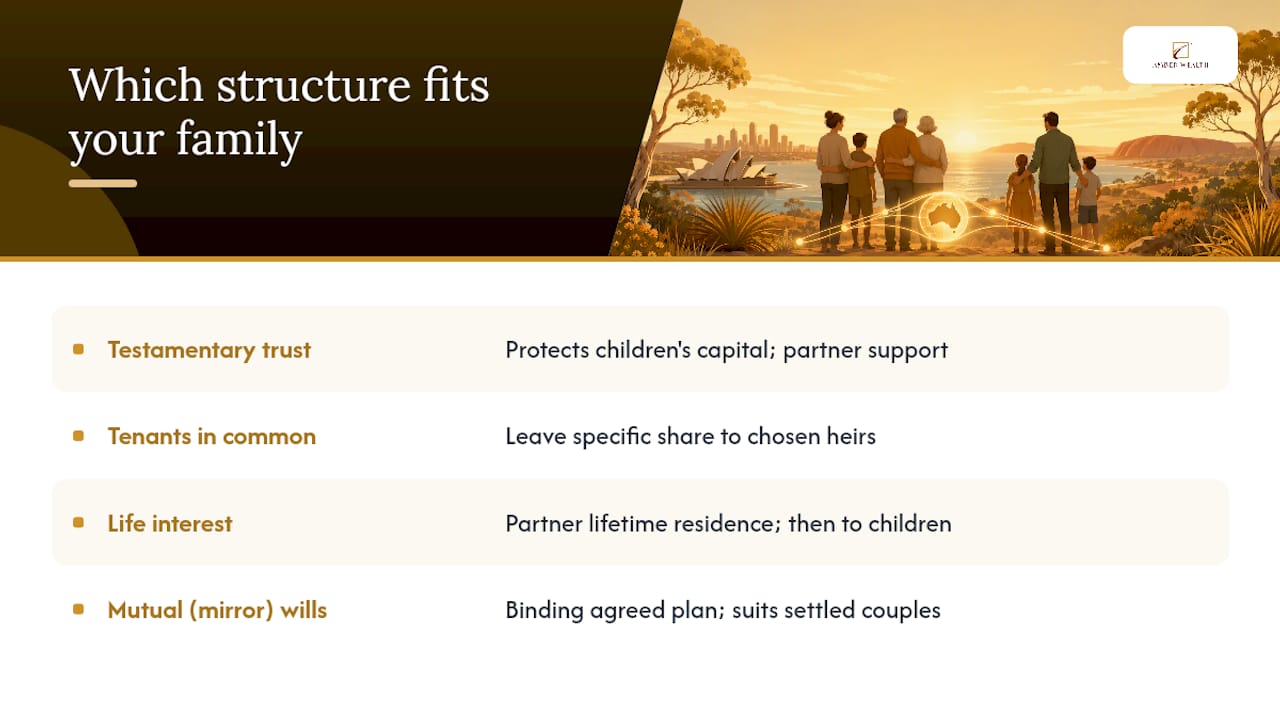
Testamentary discretionary trusts are the workhorse of blended family planning. Rather than leaving assets outright, the will creates a trust that can provide income or a right to live in the family home for a surviving partner, while ultimately preserving the capital for your biological children. Testamentary trusts also offer income-splitting advantages for minor beneficiaries, since trust income distributed to children under 18 is taxed at adult rates rather than the higher penalty rates that usually apply to minors.
Tenants in common lets you leave your specific share of a jointly owned asset to whoever you choose, rather than it passing automatically to the other owner. This suits couples who want to ring-fence part of the family home for children from a previous relationship.
Life interest or right to reside arrangements let a surviving partner live in the home for their lifetime (or until remarriage or a defined event), after which the property passes to the children named in the will. This solves the "housing versus inheritance" tension that comes up constantly in blended families: nobody wants to evict a surviving partner, but nobody wants the kids locked out permanently either.
Mutual or mirror wills bind two partners to an agreed distribution plan that neither can unilaterally change after the other dies. They can suit older, settled couples with no expectation of remarriage, but they're rigid, and poorly drafted mutual wills have generated their own body of case law over disputes about whether they were truly binding.
Pro Tip: Don't choose a structure based on what worked for a friend's family. A life interest suits a couple in their 60s with an adult family; a testamentary trust with more flexible trustee powers often suits a younger blended family where circumstances are still evolving. Read more on avoiding trustee and tax pitfalls with testamentary trusts.
Superannuation and binding death benefit nominations: what you must check now
Super is one of the biggest assets most Australians own, and it's also the one most commonly mishandled in blended family estates. Because superannuation generally passes outside the will, trustee discretion and your nomination form (not your will) determine who receives the benefit.
Statistic callout: Binding nominations under APRA-regulated super funds generally lapse every three years unless renewed, which means a nomination made shortly after a second marriage can quietly expire and default back to trustee discretion within a few years if nobody notices.
SMSFs work differently again: a self-managed fund's binding nomination is governed by the fund's own deed, not the standard APRA rule, so lapsing periods and formalities vary trust by trust.
One workaround that solicitors and advisers use often: nominate the estate as beneficiary so the death benefit flows into your will and can be directed into a testamentary trust. This gives you more control over the outcome, but it can also trigger tax on the taxable component for adult non-dependant beneficiaries, so it needs to be weighed against the alternative of a direct nomination.
- Confirm your current nomination is still valid and hasn't lapsed
- Check whether your fund is APRA-regulated or an SMSF governed by its own deed
- Decide, with advice, whether nominating your estate suits your situation better than a direct nomination
How long can someone contest a will, and who's eligible?
A will drafted with care still doesn't make an estate immune from challenge. Family provision claims let certain people apply to a court for a share (or larger share) of an estate if they believe they were unfairly left out or under provided for.
Eligible applicants typically include spouses, children, and in some circumstances stepchildren or other dependants, depending on the jurisdiction and the closeness of the relationship. Courts weigh financial need, the length of the relationship, moral obligations, and what the deceased's obligations were to other dependants at the time.
Time limits to file a family provision claim vary by state and can be quite strict, so it is important to check the relevant timeframe in your jurisdiction.
Good drafting, clear reasoning recorded alongside the will, and formal provision for likely claimants all reduce the risk of a successful challenge. None of it removes the risk entirely, which is exactly why family provision exposure deserves a specific conversation with your solicitor rather than an assumption that "the will says what I want."
Step-by-step checklist: what to update and who to call
Treat this as a working list, not a one-off task.
- Update your will to name stepchildren explicitly if you want them included, and consider a testamentary trust structure.
- Check and renew binding death benefit nominations across every super fund, including any SMSF, and confirm the deed's rules.
- Review life insurance beneficiaries to ensure they align with your current wishes, not an ex-partner or an outdated form.
- Review property title. If you hold the family home as joint tenants and want to preserve a share for specific children, consider severing the tenancy to tenants in common.
- Loop in the right professionals: a solicitor for the will and trust structure, a financial adviser for super, insurance and tax sequencing, and an accountant for capital gains tax implications on property or business assets.
- Set a review cadence. Revisit the whole plan every three years, and immediately after any major life event: remarriage, a new child, divorce, or a significant change in assets.
Pro Tip: Put a recurring calendar reminder in for your estate plan review, the same way you would for a car service. Most blended family disputes trace back to a document nobody looked at again after the first marriage ended.
Amber Wealth perspective: coordinating financial planning with legal estate structures
A solicitor can draft the trust, but they can't tell you whether recontributing to super, restructuring an insurance policy through super, or adjusting your pension drawdown will actually deliver the outcome your will intends. That's where financial planning and legal drafting need to talk to each other, not sit in separate folders.
Financial planners often work alongside clients' solicitors to model cashflow across scenarios, align super and insurance nominations with the will's intent, and sequence contributions or withdrawals so a testamentary trust actually receives what it's meant to. A common scenario: a client's intended structure assumes the family home stays with one partner, but modelling shows the pension and super drawdown wouldn't support that without selling other assets first, which changes the legal structure needed.
This is general information only, not personal financial advice, and a plan built around your specific circumstances requires a proper conversation with a qualified adviser and your solicitor together.
When biological children and stepchildren clash: real disputed scenarios
The most common source of blended family estate disputes isn't malice. It's competing, reasonable expectations that were never written down.
Picture a common scenario: a father remarries in his 50s, brings two adult children from his first marriage, and his new partner brings one child of her own. He dies without updating his will from before the remarriage. His biological children assume everything comes to them, as the will originally intended; his widow assumes she's entitled to remain in the family home, and her adult child assumes some provision was intended for them too. Nobody is wrong based on what they were told, but the will only supports one version.
Another frequent flashpoint: a surviving spouse inherits the family home outright with no trust or life interest structure, remarries, and years later that same home passes to the new spouse's family, cutting out the children from the first marriage entirely. This is the "sideways inheritance" risk in its most painful form, and it's almost always avoidable with a life interest or testamentary trust instead of an outright gift.
Disputes also flare over unequal treatment that feels fair to the parent but not to the children. Leaving more to a stepchild who lived at home longer, or less to a biological child who's already financially comfortable, is a legitimate choice. Left unexplained, it reads as favouritism and often ends up contested.
Fair asset division between partners and children from different relationships
"Fair" rarely means "equal" in a blended family, and trying to force equality can actually create more resentment than a well-reasoned, uneven split.
A workable starting point is separating assets by purpose. Assets that support your partner's day-to-day security, the family home, savings for living costs, retirement income, can be structured to protect their lifestyle through a life interest or trust income. Assets accumulated before the relationship or intended for your own children specifically, an inheritance you received, a business built pre-marriage, can be earmarked separately through tenants in common ownership or direct bequests.
Some families use a "his, hers, and ours" framework: assets each partner brought into the relationship go to their own children, assets built together during the relationship are split according to an agreed formula, and jointly used assets like the family home get a structure that protects both the surviving partner's housing and the children's eventual inheritance.
Whatever formula you land on, write down your reasoning. A short letter of wishes alongside the will, explaining why one child received more or why a stepchild was included or excluded, won't bind a court but it does give context that can blunt a family provision claim and, more importantly, spare your family a guessing game about your intentions.
Legal considerations specific to Australian blended family estates
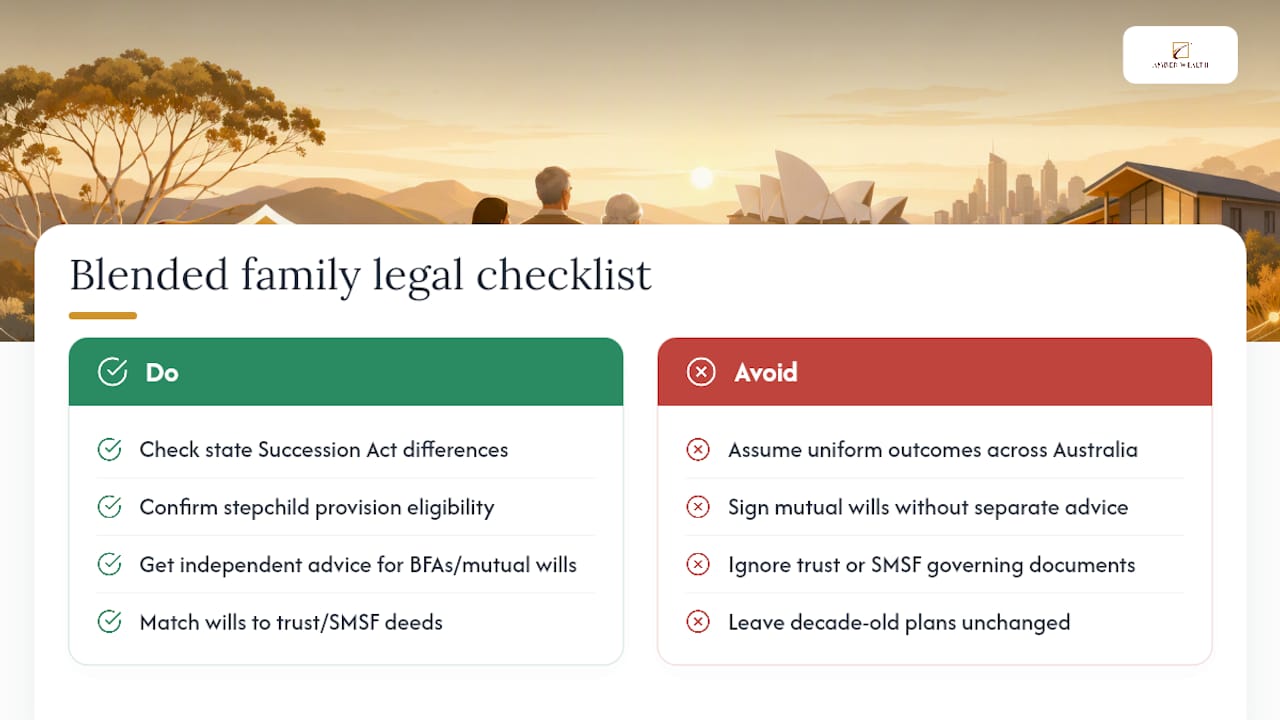
Australian succession law gives states and territories their own Succession Acts, which means the same family situation can produce different outcomes depending on where the deceased lived. This matters more for blended families than most, because stepchild eligibility for family provision claims, notional estate provisions (which can claw back certain gifts made before death in NSW), and intestacy distribution formulas all vary by jurisdiction.
Courts have increasingly scrutinised binding financial agreements and mutual wills for whether they were entered into with full understanding and independent advice, particularly where one partner was financially dependent on the other. A mutual will or BFA signed without each party getting separate legal advice is more vulnerable to challenge than one properly documented with both parties independently represented.
Property held in trusts, family companies, or self-managed super funds adds another layer, since these structures sit outside the standard will and intestacy framework and are governed by their own deeds or constitutions. A will that ignores how these entities are actually controlled can leave a spouse or children with a paper entitlement that the trust deed or SMSF rules don't actually deliver.
None of this is static. Succession law in this space shifts periodically as courts hand down decisions on notional estate clawbacks and mutual will enforceability, which is exactly why a blended family estate plan drafted a decade ago deserves a fresh look rather than an assumption it still works as intended.
Financial planning and insurance: protecting everyone fairly
Life insurance is one of the most underused tools in blended family planning, largely because people default to naming a spouse as beneficiary and never revisit it.
A life insurance policy held through superannuation follows the same binding nomination rules as your other super, which means it can bypass the will entirely if not aligned with your overall structure. One approach some advisers use is directing insurance proceeds into a testamentary trust rather than to a named individual, so the payout can provide income to a surviving partner while capital remains protected for the children eventually.
Income protection and TPD cover also deserve a second look in blended families, since a disability or income loss during your lifetime can drain the very assets you're trying to preserve for a fair distribution later. If your insurance strategy was set up before your current relationship, it's worth reviewing whether the sums insured, ownership structure, and beneficiaries still reflect your intentions today, not your circumstances a decade ago.
The goal isn't to insure every possible outcome. It's to make sure the insurance you already have (or the cover you're considering) is structured to support the same fair outcome your will and super nominations are aiming for, rather than working against them by accident.
Talking to your family: reducing disputes before they start
The single best predictor of a peaceful estate isn't the quality of the legal drafting. It's whether the family had any idea what to expect before the funeral.
Many parents avoid the conversation because it feels uncomfortable, particularly when a stepparent or stepchild is involved and the numbers aren't equal. But silence doesn't prevent disagreement, it just delays it until a moment when emotions are highest and nobody can ask you to clarify your reasoning.
A few practical starting points: tell adult children and stepchildren, in general terms, what your plan is and why, before you die rather than after. You don't need to disclose exact dollar figures, but explaining the reasoning behind a life interest or a trust structure tends to land far better as a considered decision than as a surprise read out at a solicitor's office. Where remarriage is involved, having that conversation with both your children and your new partner in the room, even briefly, can prevent two separate and conflicting stories from forming about what was promised.
Mediation and family dispute resolution: heading off a contest
Not every disagreement needs to end in court, and increasingly, it doesn't.
Family dispute resolution and mediation services give blended families a structured way to work through disagreements about an estate, either before death (while the will-maker can still clarify intentions) or after, before a formal family provision claim is lodged. Mediation is generally faster and considerably less expensive than litigation, and it keeps the conversation private rather than aired in a judgment.
Some solicitors now build a mediation clause or a family conference recommendation into the estate planning process itself, particularly where they can see early signs of tension between children and a stepparent. If you already sense friction, raising the idea of a facilitated family conversation while you're still alive and able to explain your reasoning is almost always more productive than leaving that same conversation to happen after you're gone, when nobody can ask you why.
Australia-first practicality: what the rules actually tell you to prioritise
Most blended family advice treats the will as the whole plan. It isn't. Superannuation and state-based family provision rules routinely override or undercut a beautifully drafted will, and that's the gap most families miss until it's too late to fix.
If you take one thing from the legal detail here, take this: your super nomination and your property title form carry as much weight as your will, sometimes more, because they can operate completely independently of it. A testamentary trust solves nothing if your super defaults to an ex-partner because a nomination lapsed three years ago, or if your home passes automatically to a new spouse under joint tenancy regardless of what your will says.
The conventional advice to "get a will done" undersells the actual task, which is coordination across three separate systems: succession law, superannuation law, and property law. Where I'd push back on standard estate planning guidance is the assumption that a solicitor alone can deliver a coordinated outcome. They can draft an excellent trust, but they generally aren't modelling your super tax position, your Age Pension interactions, or whether recontribution timing changes what actually lands in that trust. That's a financial planning conversation running in parallel with the legal one, not after it.
— Adam
Amber Wealth: coordinating your estate, super and insurance in one plan
Getting a will drafted is one part of the job. Making sure your super nominations, insurance structures, and property ownership actually support that will, rather than quietly undermining it, is the part most families never get around to. Amber Wealth works alongside your solicitor to review how your superannuation, personal insurance, and investments interact with your estate plan, so a testamentary trust or life interest arrangement can actually deliver the outcome it's designed for.

A typical starting point is a discovery conversation about your current documents, followed by a checklist of what needs updating (nominations, beneficiaries, title structures) and, where the legal drafting itself needs attention, a referral to a specialist estate planning solicitor. Amber Wealth's estate planning coordination service sits alongside its superannuation and SMSF advice and personal insurance review services, so nominations, cover, and retirement income can be reviewed as one connected plan rather than three separate conversations. This is general information, not personal advice. If your family situation involves a second marriage, stepchildren, or assets you want to protect for specific people, book a conversation to see how your super, insurance and estate plan line up.
Sources
Check your state's Succession Act for exact family provision time limits, the ATO's guidance on superannuation death benefits, and specialist commentary such as Simons George Legal's overview of blended family estate planning for jurisdiction-specific detail.
This article is general information, not a substitute for advice from a qualified financial advisor. Consult a qualified financial professional about your own circumstances before acting on anything here.
- Succession Act 2006 (NSW)
- Practical Law — Superannuation and blended families
- Watoday — What are mutual wills and why would I choose one?
FAQ
What are two disadvantages of a blended family for estate planning?
Blended families face a higher risk of "sideways inheritance," where assets meant for biological children end up with a stepfamily after a surviving spouse remarries. They also face a greater likelihood of family provision claims, since more people, spouses, biological children, and sometimes stepchildren, can have a legitimate claim on the same estate.
What is the best type of will for a blended family?
A will that establishes a testamentary discretionary trust is generally the most flexible option, letting a surviving partner receive income or housing rights while preserving capital for your children. Tenants in common ownership and life interest arrangements are often used alongside the trust to protect specific assets like the family home.
Do stepchildren have inheritance rights in Australia?
Stepchildren generally have no automatic entitlement under intestacy rules unless they were legally adopted, so they must be named explicitly in a will to inherit. In some states, stepchildren may still be eligible to bring a family provision claim depending on their relationship with the deceased and the circumstances.
How do I protect my estate from unintended stepchild claims?
Clear, specific language in your will, naming exactly who receives what, reduces ambiguity that can invite a claim. Structuring assets through a testamentary trust or life interest, rather than an outright gift to a surviving partner, also helps ensure your intended beneficiaries eventually receive the assets you intended for them.
Recommended
- Estate Planning Advice
- Avoid Trustee and Tax Pitfalls with Testamentary Trusts in Australia
- Age Pension Strategies
- Retirees' Estate Planning: Check Beneficiaries, Enduring POA, Pension
This article is general information, not a substitute for advice from a qualified financial advisor. Consult a qualified financial professional about your own circumstances before acting on anything here. General Advice Warning Disclaimer: The information on this website is general information only and is not intended to be a recommendation. We strongly recommend you seek advice from your financial adviser as to whether this information is appropriate to your needs & financial situation.