
If you've reached Age Pension age (currently 67), live in Australia, and your income falls under the threshold, you very likely qualify for the Commonwealth Seniors Health Card — and it costs nothing to hold. The card is issued by Services Australia (Centrelink) and gives you access to cheaper medicines under the Pharmaceutical Benefits Scheme (PBS), Medicare Safety Net benefits, and a range of state and territory concessions that can add up to real savings each year.
The two rules that catch most applicants out: you must not be receiving any other Centrelink or Department of Veterans' Affairs (DVA) income support payment, and your income must pass the CSHC income test, which includes deemed income on account-based pensions and taxable income from the ATO.
Core benefits at a glance:
- PBS concessional prescriptions at a significantly reduced rate per script, plus free scripts once you hit the PBS Safety Net
- Medicare Safety Net access, which increases your Medicare rebate once out-of-pocket costs reach the annual threshold
- Possible bulk-billing at your GP's discretion (the card can make bulk-billing more likely)
- State and territory concessions on electricity, rates, ambulance cover, public transport and more — applied separately through your state or territory portal
Table of Contents
- What is the Commonwealth Seniors Health Card?
- Who can get the CSHC — age, residency and payment rules
- How the CSHC income test works: adjusted taxable income, deeming and thresholds
- Exactly what the card gives you: PBS, Medicare Safety Net and extra concessions
- Step-by-step: how to apply for the Commonwealth Seniors Health Card
- What you must tell Services Australia — keeping the card valid
- Key takeaways
- The part most people get wrong
- How Amberwealth helps with CSHC planning and retirement strategy
- Useful sources and contact points
What is the Commonwealth Seniors Health Card?
The Commonwealth Seniors Health Card (CSHC) is a federal concession card giving eligible older Australians access to cheaper health care and other government concessions. It is specifically for people who have reached Age Pension age but do not receive the Age Pension or any other Centrelink or DVA income support payment — typically self-funded retirees or those still working past 67 whose income falls below the card's threshold.
The CSHC is not the same as the Pensioner Concession Card (PCC), which goes to Age Pension recipients, or the Low Income Health Care Card (LIHCC), which is income-tested but not age-restricted. The CSHC sits between them: age-gated, income-tested, but with no assets test at all.
You use the card by showing it at a pharmacy when filling a PBS prescription, or at a medical centre when seeking bulk-billing. For additional state and territory concessions — electricity rebates, ambulance cover, council rates discounts — you apply separately to the relevant state agency or council, using the CSHC as proof of entitlement at Commonwealth level. Service NSW is one example of a state portal that processes these additional concessions for CSHC holders.
Who can get the CSHC — age, residency and payment rules
Eligibility comes down to four conditions, all of which must be met simultaneously.
Eligibility checklist:
- Not receiving income support: — You cannot be receiving any income support payment from Services Australia or DVA (Age Pension, Disability Support Pension, DVA Service Pension, and similar payments all disqualify you)
Importantly, there is no assets test. A retiree with $2 million in superannuation can still qualify if their income, properly calculated, falls under the threshold.
Veterans and DVA: Certain veterans and war widows/widowers may be eligible from age 60 rather than 67, depending on their DVA payment history and circumstances. DVA administers the CSHC for eligible veterans separately from Services Australia, so if you receive a DVA payment, check directly with DVA about your specific situation.
Evidence requirements: Most applicants will need their most recent ATO Notice of Assessment to verify income. If you are using an estimated income (see Section 4), you must supply the actual ATO Notice of Assessment within a specified period after the end of the financial year. Identity documents — passport, birth certificate, or driver licence — are also required.
Pro Tip: Many people assume you must be fully retired to qualify. You can still be working at 67 and hold the CSHC, provided your adjusted taxable income and any deemed income on account-based pensions fall below the threshold.
How the CSHC income test works: adjusted taxable income, deeming and thresholds
The CSHC income test is the part most applicants misread, and it is worth understanding carefully before you apply.
What counts as income
Your assessable income for the CSHC is not simply your taxable income from the ATO. It is your adjusted taxable income (ATI), which adds several items back in:
- Taxable income (from your tax return)
- Reportable superannuation contributions (employer or personal deductible contributions above the standard amount)
- Reportable fringe benefits
- Net investment losses (rental property losses and investment losses that were deducted from taxable income)
- Target foreign income (foreign income not already included in your taxable income)
On top of ATI, deemed income on account-based income streams is added. If you hold an account-based pension (also called an allocated pension) that was started on or after 1 January 2015, or where certain continuity conditions are not met, the balance of that pension account is multiplied by the applicable deeming rates and the result is added to your ATI. This applies even if you made no withdrawals from the account during the year.
The Social Security Guide confirms that these non-cash items — particularly reportable super contributions and net investment losses — trip up many applicants who assume only their taxable income figure matters.
Current income thresholds
| Situation | Annual income limit |
|---|---|
| Single | $101,105 |
| Couple (living together) | $161,768 |
| Couple (separated by illness, respite or prison) | $202,210 |
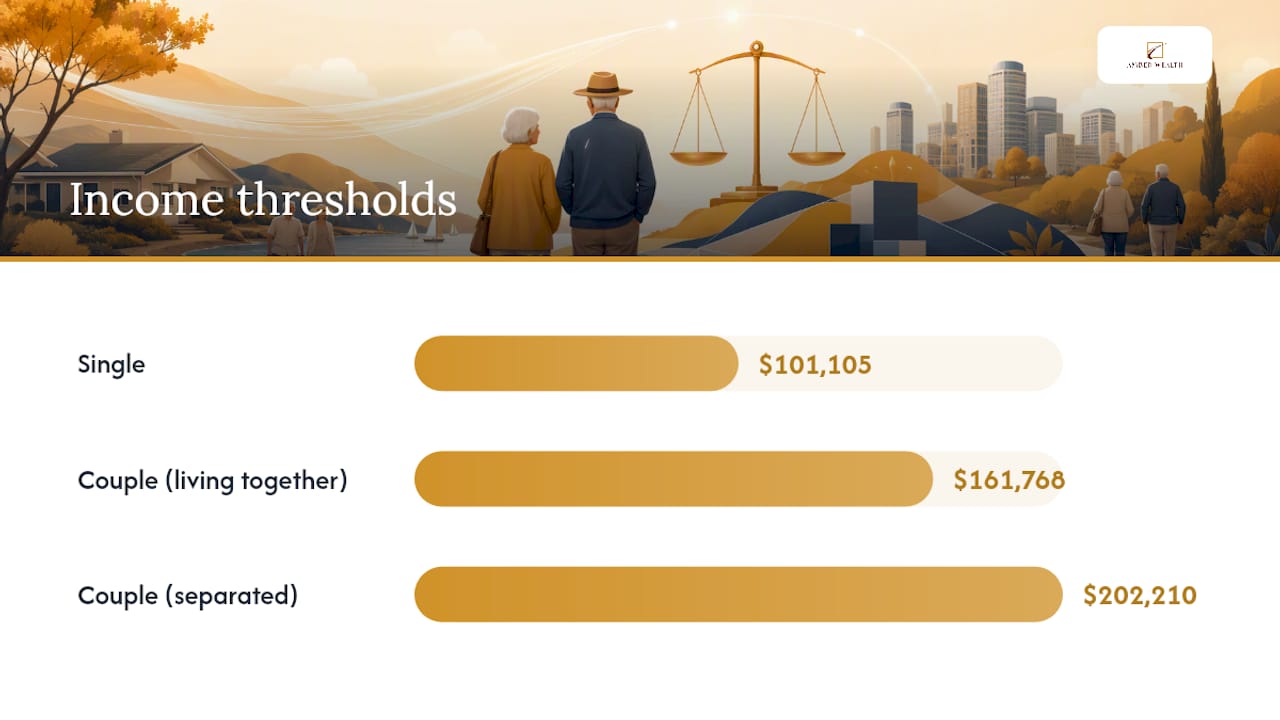
These figures are indexed on 20 September each year, so the thresholds rise slightly each spring. A small additional amount applies per dependent child.
Worked example
Say you are single, retired, and your tax return shows taxable income of $28,000 from interest and dividends. You also have an account-based pension with a balance of $600,000, started in 2016. At current deeming rates, that balance generates deemed income added to your ATI. Your reportable super contributions for the year were $5,000. Your assessed income for CSHC purposes is $28,000 plus deemed income on the $600,000 balance plus $5,000 — not just the $28,000 on your tax return. Whether the total clears the $101,105 threshold depends on the deeming rates in effect at the time.
Pro Tip: The most common mistake is confusing the Age Pension income test with the CSHC income test. They use different rules. The CSHC has no assets test and treats account-based pensions differently depending on when they were started. Run the numbers separately.
You can use an income estimate when applying if your circumstances have recently changed (for example, you just retired). If you do, you must provide your actual ATO Notice of Assessment within the timeframe Services Australia specifies after the financial year ends.
Exactly what the card gives you: PBS, Medicare Safety Net and extra concessions
Commonwealth health benefits
The PBS concessional rate means you pay a lower co-payment per prescription than the general public. Once your total PBS co-payments reach the PBS Safety Net threshold for the year, further PBS medicines are free for the rest of that calendar year. These thresholds are set annually and apply per individual or family.
The Medicare Safety Net works alongside Medicare. Once your out-of-pocket Medicare costs reach the annual threshold, Medicare covers a higher proportion of subsequent costs for the rest of the year. CSHC holders access the lower threshold applicable to concession card holders.
Bulk-billing remains at the GP's discretion, but holding the CSHC signals concession status and can increase the likelihood of being bulk-billed, particularly at practices that prioritise concession patients.
State, territory and local concessions
| Concession type | Typical availability |
|---|---|
| Electricity/gas rebates | Most states and territories |
| Council rates reduction | Many local councils |
| Ambulance cover | Some states (e.g. Queensland, Tasmania) |
| Public transport discounts | Most states |
| Dental and eye care | Selected states/territories |
| Water rates | Some states |
These concessions are not automatic. You apply to your state or territory agency using the CSHC as proof of entitlement. The value varies significantly by jurisdiction — in some states, the electricity rebate alone can be worth several hundred dollars a year. Check your state's concession portal (for example, Service NSW, Services Victoria, or SA Government's concessions page) for the current list.
Step-by-step: how to apply for the Commonwealth Seniors Health Card
Services Australia's claim process is straightforward once you have your documents ready. Here is the sequence:
- Create a myGov account at my.gov.au if you do not already have one, then link your Centrelink record to it.
- Prove your identity through myGov's identity verification process or in person at a service centre. You will need at least two identity documents (passport, birth certificate, driver licence, or Medicare card).
- Start a new claim by navigating to Centrelink within myGov and selecting "Make a claim" under Concession Cards, then choosing the Commonwealth Seniors Health Card.
- Complete the income details. You will enter your ATI or provide an income estimate if your circumstances have recently changed.
- Upload supporting documents. Your most recent ATO Notice of Assessment is the primary income evidence. If using an estimate, note the deadline for providing the actual assessment after year end.
- Submit and wait. You can also apply by phone (call Centrelink on 132 300) or by completing a paper form (SA296) and posting it to Services Australia.
Documents checklist:
- ATO Notice of Assessment (most recent)
- Proof of identity (passport, birth certificate, driver licence)
- Tax File Number (yours and your partner's)
- Partner's income details if applicable
- Details of any account-based pensions held
Once approved, the card appears in the Express Plus Centrelink app (digital wallet) and is also posted to your address. You can track your application status through myGov or by calling Centrelink. Processing times are not publicly guaranteed, but most straightforward applications are assessed within a few weeks.
Pro Tip: Apply online through myGov for the fastest outcome. Paper applications add postal time on both ends, and phone applications can require follow-up document lodgement anyway.
What you must tell Services Australia — keeping the card valid
Holding the card comes with ongoing reporting obligations. Missing a deadline can result in cancellation and, in some cases, a requirement to repay concession benefits received while ineligible.
Changes you must report:
- Income rising above the threshold (including a large super contribution or investment gain that pushes your ATI over)
- Starting a new account-based pension (which may trigger deeming)
- Change of address or extended travel overseas beyond the allowed period
- Change in relationship status (partnering, separating, or a partner's death)
- Starting to receive any Centrelink or DVA income support payment
The standard reporting timeframe is within a few weeks from when the change occurs. In some circumstances involving overseas travel or remote locations, a longer window may apply. You can report changes through myGov, the Express Plus Centrelink app, by phone, or in person at a service centre.
Failing to report a change that causes ineligibility means the card should have been cancelled from the date of that change. Services Australia can recover any PBS or other concession benefits received in the interim, and the card will be cancelled. Reapplying is possible once circumstances change again, but there is no grace period built in.
Key takeaways
The Commonwealth Seniors Health Card is one of the most accessible concessions available to self-funded retirees: no assets test, a generous income threshold, and real savings on medicines and health costs for those who qualify.
| Point | Details |
|---|---|
| Age and residency first | You must be 67 or older, an Australian resident, and not receiving any Centrelink or DVA income support. |
| Income test includes deeming | ATI plus deemed income on account-based pensions (started from 1 January 2015) must fall below $101,105 (single), $161,768 (couple living together), or $202,210 (couple separated by illness/respite/prison). |
| Thresholds rise each September | Income limits are indexed on 20 September annually — check the current figures before applying. |
| Apply via myGov | Create a myGov account, link Centrelink, and lodge your claim online with your ATO Notice of Assessment ready. |
| Amberwealth can model your eligibility | A Centrelink strategy review with Amberwealth covers income test modelling, deeming calculations, and pension timing before you apply. |
The part most people get wrong
Most of the CSHC applications I see go sideways for one of two reasons: the applicant used their taxable income figure from the ATO and forgot to add back reportable super contributions or net investment losses, or they assumed their account-based pension balance was irrelevant because they hadn't drawn it down. Both errors can push assessed income over the threshold and result in a rejection that feels unfair but is technically correct.
The good news is that these are fixable. If your income is close to the threshold, a proper review of all the components — not just the tax return figure — often reveals that the number is lower than expected, or that a small adjustment to how income is structured brings it within range. The card is worth pursuing. For most self-funded retirees, the PBS savings alone justify the hour it takes to apply, and the state concessions on top of that can be substantial.
What I'd encourage anyone near the threshold to do is get the numbers checked properly before assuming they don't qualify. The CSHC income test is not the same as the Age Pension test, and the assets-blind nature of the card means it reaches people the pension system doesn't.
How Amberwealth helps with CSHC planning and retirement strategy
For retirees and pre-retirees whose income sits near the CSHC threshold, the difference between qualifying and missing out often comes down to how income is structured, not how much is held in assets. Amberwealth specialises in exactly this kind of Centrelink strategy work: modelling your adjusted taxable income, assessing deeming on account-based pensions, and identifying whether timing adjustments can bring you within range — all within ATO and Services Australia rules.
Amberwealth serves clients across Victoria, New South Wales, South Australia and Tasmania through face-to-face and online advice. The retirement planning service covers CSHC eligibility modelling as part of a broader retirement income review, and the Age Pension strategies service goes deeper on Centrelink-specific planning for self-funded retirees. To book a Centrelink strategy review or ask whether a CSHC income check makes sense for your situation, contact Amberwealth directly through the website.
Useful sources and contact points
Official Services Australia pages:
- Commonwealth Seniors Health Card — Services Australia
- How to claim a Commonwealth Seniors Health Card — Services Australia
- Commonwealth Seniors Health Card income test — DVA policy library
- 3.9.3.30 Assessment of income for CSHC — Social Security Guide
- Applying for a Commonwealth Seniors Health Card — Service NSW
DVA and policy references:
- Social Security Guide — CSHC income assessment — ATI components and estimate documentation rules
State concession portals:
Contact numbers:
| Service | Phone |
|---|---|
| Centrelink (older Australians line) | 132 300 |
| DVA general enquiries | 132 300 |
| myGov support | 132 300 |
myGov and digital wallet: Access your CSHC digitally through the Express Plus Centrelink app once your claim is approved. The physical card is also posted to your address.
Amber Wealth Pty Ltd (ABN 16 653 279 013) is a Corporate Authorised Representative (No. 1310815) of Lifespan Financial Planning Pty Ltd (ABN 23 065 921 735), holder of Australian Financial Services Licence (AFSL) No. 229892. Financial advice is provided by Adam Sobczak, ASIC Authorised Representative No. 1234769.
General Advice Warning Disclaimer: The information on this website is general information only and is not intended to be a recommendation. We strongly recommend you seek advice from your financial adviser as to whether this information is appropriate to your needs, financial situation and investment objectives. Whilst every care has been taken in the preparation of this website, Amber Wealth Pty Ltd, its directors, authors, consultants, editors and any persons involved in the construction of this website, expressly disclaim all and any form of liability to any person in respect of this website and any consequences arising from its use of this information.