

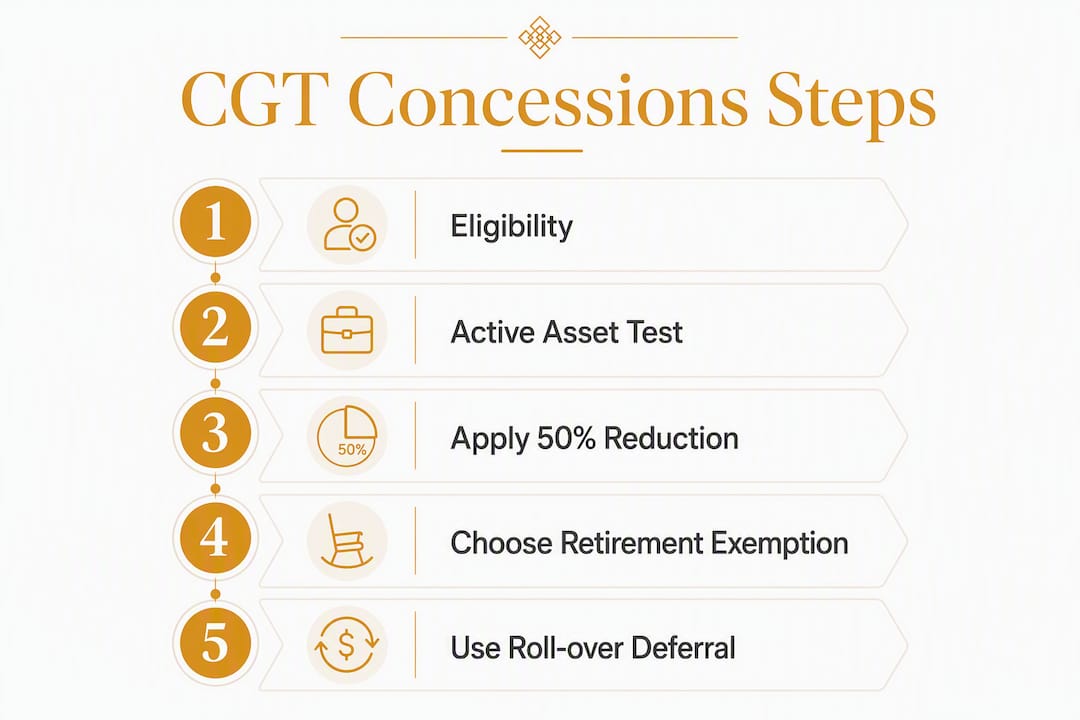
Australian small business owners selling a business asset can access four CGT concessions: the 15-year exemption, the 50% active asset reduction, the retirement exemption, and the small business roll-over. These concessions can reduce, disregard, or defer a capital gain — sometimes to zero. The trigger to check first is whether the asset qualifies as an active asset and whether the entity meets the small business eligibility tests.
Before reading further, run through this quick checklist:
- Owner type: Are you a sole trader, partner, trust beneficiary, or shareholder in a company that owns the asset?
- Asset type: Is the asset actively used in the business (not held passively for rent or investment)?
- Turnover or net assets: Does the entity have aggregated turnover under the ATO's current small business entity threshold, or does it pass the maximum net asset value test?
- Ownership period: Have you held the asset for at least 12 months (for the CGT discount) or 15 years (for the full exemption)?
If you tick the first three boxes, you are likely eligible for at least one concession. The sections below explain each one, how to apply them in the right order, and where the traps are.
Table of Contents
- Who can use the small business CGT concessions?
- How the 50% active asset reduction works
- The 15-year exemption: full disregard of the gain
- The retirement exemption: $500,000 lifetime limit and super interaction
- The small business roll-over: deferring the gain
- How to apply the concessions in the right order
- Claiming the concessions: lodgment steps and record-keeping
- Common mistakes and when to get professional help
- Amberwealth's adviser perspective: concessions, retirement and super
- Key takeaways
- Why the concessions reward planning, not luck
- Amberwealth helps you plan your business exit and retirement together
- Useful sources and further reading
Who can use the small business CGT concessions?
The ATO sets out two main eligibility routes, and you only need to satisfy one of them — plus the active asset test.

The two small business eligibility tests
Small business entity test: Your entity's aggregated turnover must be under $2 million for the income year in which the CGT event occurs. Aggregated turnover includes the annual turnovers of any affiliates and connected entities — not just your own business.
Maximum net asset value (MNAV) test: If your turnover exceeds $2 million, you may still qualify if the net value of CGT assets owned by you, your affiliates, and connected entities does not exceed the threshold set by the ATO. Consult current ATO guidance for the operative threshold, as it applies to the combined asset base of the group, not just the selling entity.
What counts as an active asset?
An asset is active if it is used, or held ready for use, in carrying on a business by you or a connected entity. The most common active assets are business premises, goodwill, plant and equipment, and intellectual property used in the business. Passive assets — shares held for investment, rental properties not used in the business, and cash or financial instruments — generally do not qualify.
There is a time-based test too: for assets held for 15 years or more, the asset must have been active for at least 7.5 years. For assets held for less than 15 years, it must have been active for at least half the ownership period.
Affiliates, connected entities, and why they matter
| Test | What it measures | Key threshold |
|---|---|---|
| Small business entity | Aggregated turnover (you + affiliates + connected entities) | Under $2 million |
| Maximum net asset value | Net CGT asset value (you + affiliates + connected entities) | Refer to current ATO guidance |
| Active asset (time) | Period asset was active vs total ownership period | At least half, or 7.5 years for 15+ year assets |
| CGT discount ownership | Minimum holding period for the 50% CGT discount | At least 12 months |
An affiliate is an individual or company that acts in accordance with your directions or wishes, or whose directions you follow. A connected entity is one you control (or that controls you) — typically a company where you hold 40% or more of the voting power, or a trust where you are a beneficiary with 40% or more of the income or capital.
These definitions catch more entities than most owners expect. A family trust that distributes to you, a company you control, and a spouse's business can all be pulled into the aggregated turnover calculation.
Pro Tip: If your entity sits close to the $2 million turnover threshold, have an adviser review the affiliate and connected entity definitions before you assume you qualify. A single overlooked related entity can push aggregated turnover over the limit and disqualify you from the small business entity test — leaving the MNAV test as your only option.
Trusts add another layer: when a trust applies the concessions and distributes a discounted capital gain to beneficiaries, special gross-up rules apply. Companies are ineligible for the CGT discount, so the distribution mechanics differ depending on whether the beneficiary is an individual, a company, or another trust.
How the 50% active asset reduction works
The 50% active asset reduction cuts the remaining capital gain in half after you have applied capital losses and the general CGT discount. It applies automatically — you do not need to elect it — unless you choose to opt out.
Worked calculation
Assume a sole trader sells business goodwill (an active asset held for more than 12 months) and has no capital losses to apply.
- Less: 50% active asset reduction: — $100,000
The combined effect of the CGT discount and the active asset reduction significantly reduces the capital gain before any further concessions.
When you might elect out
The 50% reduction applies automatically, but opting out can be strategically worthwhile. If you intend to apply the retirement exemption to the remaining gain, a larger pre-reduction amount gives you more room to use the $500,000 lifetime limit. For companies and trusts, where the CGT discount is unavailable or restricted, electing out of the 50% reduction and directing the full gain into the retirement exemption can produce a better outcome. Modelling both paths before lodging is the standard adviser approach.
The 15-year exemption: full disregard of the gain
The 15-year exemption is the most powerful of the four concessions. If you qualify, the entire capital gain is disregarded — no tax, no further concessions needed, and no interaction with other CGT events.
Core qualifying conditions
- You must have continuously owned the asset for the minimum ownership period required by the ATO's small business 15-year exemption.
- The relevant individual (the owner, or the significant individual in a company or trust) must be aged 55 or over and retiring, or be permanently incapacitated.
- The asset must satisfy the active asset test throughout the relevant period.
Because the gain is fully disregarded, you cannot then apply the 50% reduction, retirement exemption, or roll-over to that same gain. The 15-year exemption is all or nothing.
Example: retiring owner after 18 years
A 58-year-old sole trader sells a business she has owned and actively operated for 18 years. She is winding down to retire. The sale produces a $900,000 capital gain. Because she meets the 15-year continuous ownership test and the age-and-retirement condition, the entire $900,000 is disregarded. She pays no CGT on the sale.
Amounts disregarded under the 15-year exemption can also be contributed to superannuation without counting toward the non-concessional contribution cap in certain circumstances — a significant planning opportunity for owners approaching retirement.
Documents to retain
- Ownership records showing continuous ownership from acquisition date (contracts, title documents, share registers).
- Evidence of the retirement or incapacity event (age confirmation, medical certificates for incapacity, board resolutions or business closure records).
- Active asset evidence for the full 15-year period (financial statements, BAS lodgments, lease agreements showing business use).
- Written record of the choice to apply the exemption, kept with the tax return for the relevant year.
The ATO can audit CGT concession claims years after lodgment. Contemporaneous records are far easier to produce than reconstructed ones.
The retirement exemption: $500,000 lifetime limit and super interaction
The retirement exemption lets you exclude a capital gain from assessable income up to a lifetime limit of $500,000 per individual. Unlike the 15-year exemption, you do not need to be retiring or reach a particular age — but there is a critical condition for those under 55.
The under-55 super requirement
If you are under 55 when you choose the retirement exemption, the exempt amount must generally be paid into a complying superannuation fund or retirement savings account. This is not optional. The ATO treats it as a forced savings mechanism: the tax benefit is granted on the basis that the money goes into super rather than into your pocket.
For someone aged 45 selling a business for a significant gain, this means a potentially large super contribution arriving at a time when the fund's investment horizon is long — which can be a genuine planning advantage. The catch is cashflow: if the sale proceeds are tied up in the business or used to pay down debt, finding the cash to make the super contribution can be difficult.
Example scenario
A 48-year-old business owner sells her share of a partnership. After applying the CGT discount and the 50% active asset reduction, the remaining capital gain is $180,000. She elects the retirement exemption for the full $180,000. Because she is under 55, she must contribute $180,000 to her complying super fund. The contribution is treated as a CGT cap amount and does not count toward her non-concessional cap.
Her assessable capital gain for the year: $0.
Pro Tip: The retirement exemption interacts with the Age Pension assets test because super balances count as assessable assets once you reach Age Pension age. A large super contribution made via the retirement exemption can reduce Age Pension entitlements years later. Model the long-term impact before electing, not just the immediate tax saving.
The lifetime limit of $500,000 is cumulative across all years and all businesses. If you used $200,000 of the limit on a previous business sale, only $300,000 remains available for future events.
The small business roll-over: deferring the gain
The roll-over concession lets you defer all or part of a capital gain rather than disregarding it. The gain does not disappear — it is carried forward and becomes assessable when a trigger event occurs.
How deferral works
The mechanics follow a straightforward sequence:
Sell asset → elect roll-over → acquire replacement asset (or improve existing asset) → deferred gain carried over to the replacement asset's cost base.
The replacement asset must be acquired, or a capital improvement made to an existing active asset, within the required window. Generally, the replacement or improvement must occur in the period from one year before to two years after the CGT event, though the ATO can extend this in certain circumstances.
When the deferred gain becomes assessable
The deferred gain crystallises when:
- You sell the replacement asset without applying another concession.
- The replacement asset ceases to be an active asset.
- You stop using the replacement asset in the business.
- The required replacement period expires without a qualifying acquisition or improvement.
Timing checklist for the roll-over
- Note the CGT event date (usually the contract date for a sale).
- Calculate the replacement window: one year before to two years after the event.
- Identify the replacement asset or qualifying improvement.
- Keep written records of the roll-over election and the replacement asset's acquisition details.
- Review the replacement asset's status annually to confirm it remains active.
The roll-over is most useful when you are reinvesting in another business asset and want to defer the tax liability while you rebuild. It is not a permanent exemption, and failing to acquire a replacement asset within the window means the deferred gain becomes assessable in the year the window closes.
How to apply the concessions in the right order
Multiple concessions can apply to a single capital gain, and the order matters. The ATO prescribes a sequence, and deviating from it — or failing to model alternatives — can cost you significantly.
The ATO's prescribed sequence
The ATO's stepwise process for applying concessions runs as follows:
- Step 1: Check basic eligibility (active asset test, small business entity or MNAV test).
- Step 2: Apply the 15-year exemption if eligible — if it applies, stop here. The gain is fully disregarded.
- Step 3: Apply any current-year capital losses and prior-year net capital losses.
- Step 4: Apply the 50% CGT discount (individuals and trusts with assets held more than 12 months).
- Step 5: Apply the 50% active asset reduction (automatic unless you elect out).
- Step 6: Apply the retirement exemption to any remaining gain (up to the $500,000 lifetime limit).
- Step 7: Apply the roll-over to any remaining gain.
Strategic decision point: should you take the 50% reduction?
The 50% reduction is automatic, but accepting it is not always optimal. Consider two paths for a sole trader with a $400,000 gain after the CGT discount:
| Step | Path A: take 50% reduction | Path B: elect out, use retirement exemption |
|---|---|---|
| After CGT discount | $200,000 | $200,000 |
| 50% active asset reduction | $100,000 | Not applied |
| Retirement exemption applied | $100,000 (full remaining gain) | $200,000 (full remaining gain) |
| Assessable capital gain | $0 | $0 |
| Retirement exemption used | $100,000 | $200,000 |
| Lifetime limit remaining | $400,000 | $300,000 |
Both paths produce a $0 assessable gain in this example. The difference is how much of the $500,000 lifetime limit you consume. Path A preserves $100,000 more of the lifetime limit for future events. Path B is better if you want to maximise the super contribution (for under-55s) or if you have no future business sales planned.
For larger gains where the retirement exemption cannot cover the full amount, the 50% reduction first reduces the amount that must be covered by the exemption or roll-over — which can be decisive.
Claiming the concessions: lodgment steps and record-keeping
Choosing a small business CGT concession is a formal election that must be made before you lodge the income tax return for the year the CGT event occurred. You cannot go back and elect a concession after lodgment in most circumstances.
Practical lodgment steps
- Calculate the capital gain and apply losses before considering concessions.
- Determine which concessions you are eligible for and model the outcomes.
- Make the written choice for the retirement exemption (and document the amount chosen) before lodging.
- Include the relevant amounts in your tax return: the net capital gain after concessions, and any retirement exemption amount to be contributed to super.
- For the roll-over, record the election and the replacement asset details.
Records to retain
- Ownership evidence: contracts of sale and purchase, title documents, share registers, trust deeds.
- Active asset evidence: financial statements, BAS lodgments, lease agreements, business activity records covering the full ownership period.
- Concession calculations: your working papers showing each step of the calculation.
- Written choices: the retirement exemption choice document, roll-over election records.
- Trust distributions: trustee resolutions, beneficiary statements, gross-up calculations where applicable.
- Super contribution records: fund receipt confirmation for retirement exemption amounts paid to super.
The ATO expects you to retain records for at least five years after the relevant tax return is lodged, though for CGT events the practical standard is to keep records until the asset is sold and the concession period has fully closed.
Pro Tip: Advisers typically prepare a concession calculation workbook that sits alongside the tax return file — a single document showing the gross gain, each step of the reduction, the concession elected, and the supporting evidence. If the ATO queries the claim two or three years later, this workbook is the first thing you hand over.
Timing traps
A late choice is generally not available. If you miss the lodgment deadline without a valid reason, the concession is lost for that year. Amended returns can sometimes correct errors in calculation, but they cannot introduce a new concession election that was never made. Document your choice contemporaneously — on the day you decide, not the day you lodge.
Common mistakes and when to get professional help
The small business CGT concessions are detailed rules with hard edges. Getting them wrong means unexpected tax bills, ATO amendments, and sometimes penalties.
The most common errors
- Forgetting the under-55 super requirement: — Electing the retirement exemption without arranging the super contribution is a compliance failure. The ATO can deny the exemption if the contribution is not made.
Consequences of getting it wrong
An incorrect concession claim can result in an ATO amendment increasing the assessable gain, interest on the underpaid tax, and administrative penalties. For the retirement exemption, failure to make the required super contribution means the exemption is not valid — the gain remains assessable, and the tax plus interest accrues from the original lodgment date.
Seek professional help when: the asset is partly passive, the entity structure involves trusts or companies, aggregated turnover is close to $2 million, the retirement exemption interacts with super caps, or the sale is part of a broader business exit or succession plan.
Amberwealth's adviser perspective: concessions, retirement and super
The concessions do not operate in isolation. At Amberwealth, the most valuable work happens when CGT planning is integrated with the client's broader retirement and superannuation strategy — not treated as a standalone tax election made at lodgment time.
A case study outline
Consider a client under 55 who sells a business interest producing a $350,000 capital gain after losses. After the CGT discount, the gain is $175,000. The client elects out of the 50% active asset reduction and applies the retirement exemption to the full $175,000. Because she is under 55, the $175,000 must be contributed to her complying super fund as a CGT cap amount — outside the non-concessional cap.
The result: zero assessable capital gain, a $175,000 super contribution that does not erode her annual contribution cap, and a retirement balance that compounds for another decade before she accesses it. The tax saving is real, but the compounding effect on the super balance is where the long-term value sits.
Adviser checklist for concession analysis
- Confirm active asset status and ownership period before any other step.
- Run both the small business entity test and the MNAV test — use whichever qualifies.
- Model at least two concession sequences (with and without the 50% reduction).
- Check the retirement exemption lifetime limit balance from prior years.
- Assess the super contribution against current-year and carry-forward concessional caps.
- Review superannuation advice implications: will the contribution affect the transfer balance cap or total super balance thresholds?
- Consider Age Pension asset test implications if the client is within 10 years of pension age.
- Review estate planning: how do business sale proceeds interact with the estate structure?
Pro Tip: The best time to plan concession elections is before the sale contract is signed, not after. Timing the CGT event across financial years, structuring the retirement exemption contribution, and aligning with super contribution windows all require lead time. A client who calls after settlement has far fewer options than one who calls six months before.
Key takeaways
The four small business CGT concessions — 15-year exemption, 50% active asset reduction, retirement exemption, and roll-over — can reduce a capital gain to zero, but only if you meet the eligibility tests, apply them in the ATO's prescribed order, and document every choice before lodging.
| Point | Details |
|---|---|
| Active asset test is the gateway | Every concession requires the asset to be active; passive assets are excluded regardless of turnover. |
| Two eligibility routes exist | Aggregated turnover under $2 million, or the maximum net asset value test — you only need to satisfy one. |
| Order of application matters | Apply the 15-year exemption first; then losses, CGT discount, 50% reduction, retirement exemption, roll-over. |
| Retirement exemption has a $500,000 lifetime limit | Under-55s must contribute the exempt amount to super; this interacts with super caps and Age Pension planning. |
| Amberwealth integrates concession planning with retirement strategy | Seek advice before the sale contract is signed to model concession sequences and super contribution timing. |
Why the concessions reward planning, not luck
Most business owners encounter these concessions once — at the point of sale. That timing is the problem. The decisions that determine how much tax you pay are usually made months or years before settlement: how the asset is structured, whether the entity qualifies, how long you have held it, and whether your super fund is positioned to receive a contribution.
The 50% active asset reduction is automatic, which gives it the feel of a free gift. But accepting it without modelling the retirement exemption alternative can cost you $100,000 or more of unused lifetime limit — limit you cannot recover later. The 15-year exemption is genuinely powerful, but it requires 15 years of clean ownership records, and many owners cannot produce them.
What the ATO's framework rewards is preparation. Owners who plan their exit two or three years out, with an adviser who understands both the tax rules and the retirement implications, consistently achieve better outcomes than those who treat the concessions as a post-settlement paperwork exercise. The rules are the same for everyone; the difference is when you start applying them.
Amberwealth helps you plan your business exit and retirement together
Selling a business is one of the largest financial events of your life. The tax outcome depends on decisions made well before settlement — and those decisions interact directly with your retirement planning, superannuation strategy, and long-term wealth position.

Amberwealth works with business owners across Victoria, New South Wales, South Australia, and Tasmania to integrate CGT concession planning with retirement and super advice. The services most relevant to a business exit include retirement planning, superannuation and SMSF advice, tax-effective wealth structuring, Age Pension strategy, and estate planning.
When you engage Amberwealth, the process starts with a structured assessment: reviewing your business structure, asset ownership records, aggregated turnover, super balances, and retirement timeline. From there, the team models concession sequences, super contribution options, and the downstream effects on Age Pension entitlements and estate planning.
To book an initial assessment, bring your profit and loss statements, asset ownership records, trust deeds (if applicable), and your most recent super statements. Book a conversation with the Amberwealth team at amberwealth.com.au/services.
This article provides general information only and is not personal financial or tax advice. Confirm your eligibility and concession choices with a registered tax agent or financial adviser before lodging.
Useful sources and further reading
The ATO is the definitive source for small business CGT concession rules. The pages below cover the core rules, eligibility conditions, and concession mechanics:
- Small business CGT concessions — ATO overview: The starting point — covers all four concessions and links to each in detail.
- CGT concessions eligibility overview — ATO: Eligibility steps, the prescribed order for applying concessions, and superannuation interaction rules.
- Small business 50% active asset reduction — ATO: Detailed rules for the automatic 50% reduction, including trust gross-up rules and the election to opt out.
- CGT concessions for small business guide — ATO: The ATO's comprehensive guide covering all four concessions, thresholds, and worked examples.
For Amberwealth services relevant to business exit and CGT planning:
- Retirement planning advice — Amberwealth: How Amberwealth integrates tax events with retirement income planning.
- Superannuation and SMSF advice — Amberwealth: Super contribution strategies, including CGT cap amounts and retirement exemption contributions.
- Age Pension strategies — Amberwealth: How business sale proceeds and super contributions interact with Centrelink assessments.
- Estate planning advice — Amberwealth: Succession and estate structuring for business owners after a sale event.