

If your spouse's applicable income (assessable income, reportable fringe benefits, and reportable employer super contributions) is under $40,000 this financial year, you can make a direct after-tax contribution to their super and claim a tax offset of up to $540. The offset is 18% of up to $3,000 contributed, and it phases out completely once your spouse's income hits $40,000. A separate strategy, contribution splitting, lets you roll up to 85% of your own concessional contributions into your spouse's account, but it does not attract the same tax offset.
Two methods, two different outcomes:
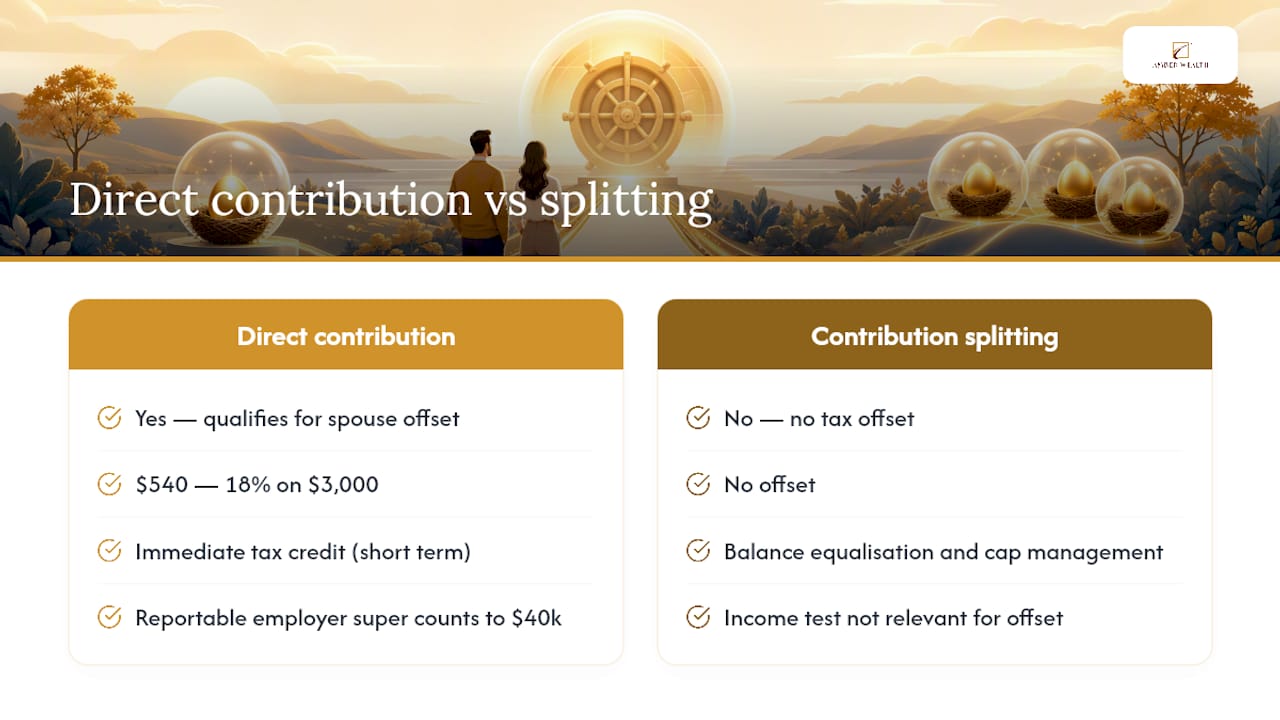
- Direct spouse contribution (after-tax/non-concessional): you pay into your spouse's fund, they receive a non-concessional contribution, and you claim the spouse contribution tax offset in your own tax return.
- Contribution splitting (rollover of concessional contributions): you redirect up to 85% of your own employer or salary-sacrifice contributions to your spouse's account after the income year ends. No tax offset applies.
The household that benefits most is one where a partner is on a low income or out of the workforce, for example caring for children or studying. Before you pay anything, check three things: your spouse's Tax File Number (TFN) is on file with their fund, their total income for the year (including reportable fringe benefits and reportable employer super contributions), and their total super balance.
Maximum spouse contribution tax offset: $540 per year (18% of $3,000, available when the receiving spouse's income is under $37,000).
Key takeaways
Making a direct spouse super contribution up to the eligible cap when your spouse's applicable income is under $37,000 delivers the maximum tax offset, but checking caps, TFNs, and income components first is what makes the strategy actually work.
| Point | Details |
|---|---|
| Maximum offset is $540 | Claim 18% of up to $3,000 contributed; offset phases out between $37,000 and $40,000 of spouse's applicable income (includes assessable income, reportable fringe benefits, and reportable employer super contributions). |
| Income test uses three components | Include assessable income, reportable fringe benefits, and reportable employer super contributions, not taxable income alone. |
| Splitting does not attract the offset | Contribution splitting is a rollover; only direct after-tax spouse contributions qualify for the tax offset. |
| Check caps before paying | A spouse contribution counts against the receiving spouse's non-concessional cap; verify total super balance first. |
| Amberwealth can model complex scenarios | For high balances, Centrelink interactions, or multiple strategies, personalised retirement planning advice prevents costly cap errors. |
Table of Contents
- The two ways to put money into your spouse's super
- Who can claim the spouse contribution tax offset and how it is calculated
- How to make a spouse contribution and claim the offset
- How contribution splitting works
- Contribution caps, total super balance limits, and interactions with other government schemes
- Common mistakes that cost people time or money
- Three worked examples
- When to get advice and how spouse contributions fit a broader retirement plan
- The spouse contribution offset is underused, and the reason is usually a misunderstanding
- Retirement planning that accounts for every contribution strategy
- Sources
The two ways to put money into your spouse's super
Understanding the difference between a direct spouse super contribution and contribution splitting matters before you do anything else. They look similar on the surface but work very differently in practice.
Direct spouse contributions
A direct spouse contribution is an after-tax (non-concessional) payment you make from your own money into your spouse's super fund. It counts as your spouse's non-concessional contribution, not yours. Because it comes from after-tax dollars and you are not claiming a deduction for it, you may be eligible for the spouse contribution tax offset. The full eligibility rules confirm the maximum offset is $540.
This method suits households where one partner has a low income and a relatively small super balance. A caregiver returning to part-time work, for example, gets a direct boost to their retirement savings and you get a tax offset in the same year.
Contribution splitting
Contribution splitting is a rollover, not a new contribution. You apply to your fund after the end of the income year to redirect up to 85% of your concessional contributions (employer contributions and salary sacrifice) into your spouse's account. The amount split counts against your own concessional cap for the year it was earned, not your spouse's cap. No new money enters the super system, and the superannuation-related tax offsets rules are clear: the spouse contribution offset cannot be claimed for contributions that are rollovers or splits.
Splitting works well for rebalancing balances before retirement, particularly when one partner is approaching the transfer balance cap faster than the other.
Side-by-side comparison
Who can claim the spouse contribution tax offset and how it is calculated
Eligibility checklist
To claim the offset, every one of these conditions must be met:
- Receiving spouse's income test: their assessable income, plus reportable fringe benefits, plus reportable employer super contributions must total less than $40,000. Using taxable income alone is a common mistake; the ATO worksheet requires all three components.
- Residency: both you and your spouse must be Australian residents at the time of the contribution.
- Age: your spouse must be under 75 at the time of the contribution. (If they are aged 67–74, the fund may also require them to meet a work test or work test exemption.)
- Not living separately: you and your spouse must not be living apart on a permanent basis.
- Non-deductible contribution: the contribution must be after-tax money you are not claiming as a personal deduction.
- Complying fund or RSA: the contribution must go to a complying superannuation fund or a Retirement Savings Account (RSA).
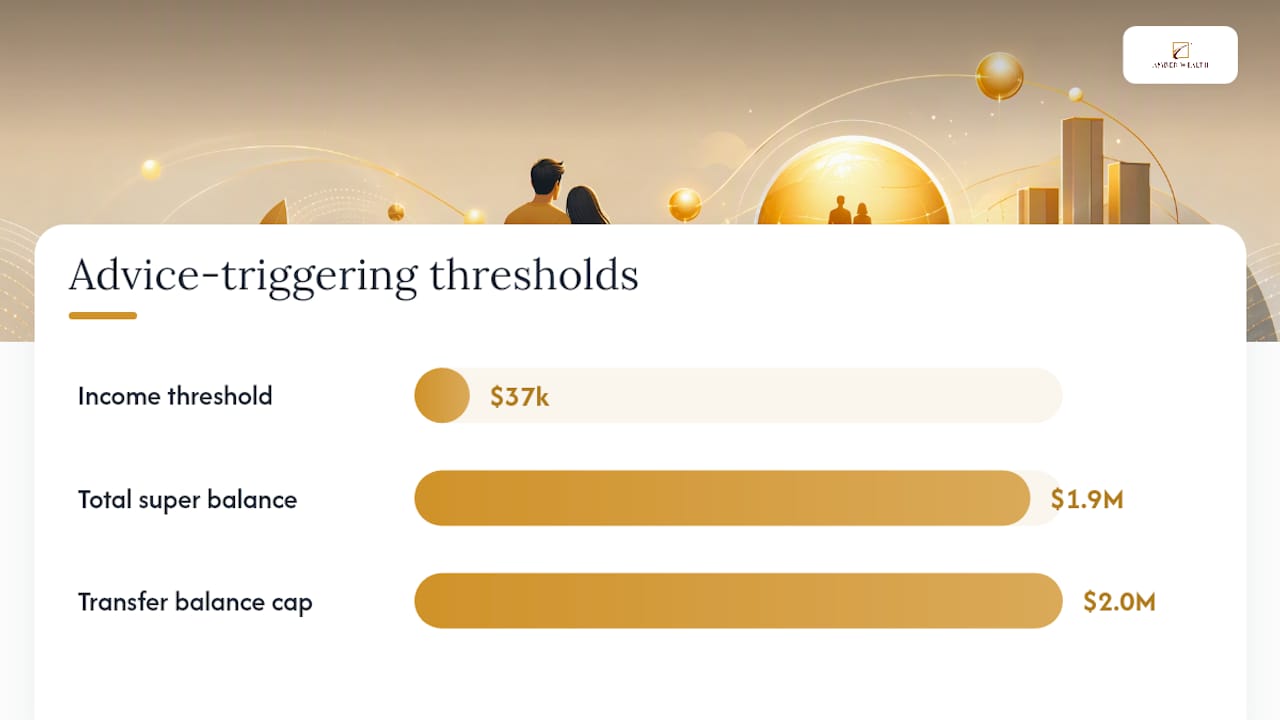
- Total super balance and non-concessional cap: if your spouse's total super balance is $1.9 million or more (check the current threshold each year), site each year), their non-concessional cap may be nil, which blocks further contributions entirely.
How the offset is calculated
The ATO uses a two-step formula. First, calculate the maximum eligible contribution amount:
Adjusted maximum = $3,000 minus $1 for every $1 the spouse's applicable income exceeds $37,000
So if your spouse earns exactly $38,500, the adjusted maximum is $3,000 minus $1,500 = $1,500.
Second, the offset is 18% of the lesser of:
- the adjusted maximum, or
- the total contributions you actually paid.
The myTax worksheet walks through these rows exactly. Enter your spouse's income components and your contribution amount, and myTax calculates the offset for you.
Offset phases out completely at $40,000 of the receiving spouse's applicable income. At that point, the adjusted maximum reaches zero and no offset is available regardless of how much you contribute.
Edge cases to know:
- If you had more than one spouse during the year, you can claim the offset for contributions made to each, subject to the combined $3,000 cap across all contributions.
- Contributions that are rollovers or family law splits do not qualify, even if they end up in a spouse's account.
- If the contribution would push your spouse over their non-concessional cap, the excess contributions may be subject to additional tax rather than the offset.
How to make a spouse contribution and claim the offset
Step-by-step payment process
- Confirm your spouse's TFN is on file. Their fund must hold their TFN before accepting a contribution. Without it, the fund may return the payment or apply a higher tax rate.
- Get the correct BPAY details or contribution form. Log into your spouse's fund portal or call the fund to get the BPAY biller code and reference number assigned to their account. Larger funds such as AustralianSuper publish spouse contribution BPAY details directly on their website. Smaller funds may require a manual contribution form.
- Label the payment correctly. When paying, identify it as a spouse contribution and include your spouse's member number. This prevents the fund from treating it as a personal contribution in your name.
- Pay before 30 June. The contribution must reach the fund's account by 30 June for it to count in that financial year. Allow several business days for BPAY processing.
- Keep your receipt. Save the BPAY confirmation, bank statement, and any fund acknowledgement. You will need the contribution amount and date for your tax return.
Claiming in myTax
In myTax, navigate to Tax offsets > Other tax offsets > Super contributions on behalf of your spouse. Enter:
- your spouse's applicable income (assessable income + reportable fringe benefits + reportable employer super contributions)
- the total contributions you paid during the year
myTax calculates the offset automatically using the ATO's T3 worksheet logic. If you lodge a paper supplementary return, complete the T3 question and the corresponding worksheet.
Documents to keep for at least five years:
- BPAY confirmation or bank transfer receipt
- Fund's written acknowledgement of the contribution
- Your spouse's income statement or payment summary showing all three income components
- A note of the contribution date and amount
How contribution splitting works
Contribution splitting lets you redirect a portion of your own concessional contributions, including employer contributions and salary sacrifice, into your spouse's super account. The usual limit is 85% of the concessional contributions you made in the prior income year.
Key rules:
- You apply after the income year ends, using your fund's own splitting form or the ATO's Superannuation contributions splitting application (NAT 15237).
- The split is processed as a rollover. It does not count as a new contribution for your spouse, and it does not attract the spouse contribution tax offset.
- The amount split counts against your own concessional cap for the year the contributions were made, not your spouse's cap for the year the split occurs.
- Funds are not required to offer splitting. Check with your fund before assuming it is available, and ask about any fees or processing timelines.
- If you are leaving your fund (for example, changing jobs), you can apply to split in the same income year rather than waiting until after year end.
When splitting makes sense: a higher-earning partner with a large super balance can redirect contributions to a lower-balance spouse, reducing the risk of one partner hitting the transfer balance cap well before the other. It does not save tax in the year of splitting, but it can improve long-term tax efficiency in retirement.
Pro Tip: If your spouse is also eligible for the government co-contribution (they earn under the co-contribution income threshold and make personal after-tax contributions to their own fund), a direct spouse contribution from you does not count toward their co-contribution entitlement. The co-contribution only applies to contributions the member makes themselves. Keep the two strategies separate.
Contribution caps, total super balance limits, and interactions with other government schemes
How caps apply
A direct spouse contribution counts as the receiving spouse's non-concessional contribution. The general non-concessional cap is $120,000 per year (check the current threshold each year), for the current figure each income year). If your spouse's total super balance is at or above the general transfer balance cap, their non-concessional cap drops to nil and no further non-concessional contributions can be made.
The general transfer balance cap moved to $2 million for the 2025–26 income year. This is a hard ceiling on the total amount that can be transferred into the tax-free retirement phase. It affects eligibility for certain offsets and payments, so check your spouse's current balance before contributing.
For a plain-English breakdown of how concessional and non-concessional contributions count toward caps, Moneysmart's contributions guide is a reliable starting point.
Caps summary
| Cap type | How it applies to spouse contributions | Practical note |
|---|---|---|
| Non-concessional cap ($120,000/yr) | Counts against receiving spouse's cap | Check spouse's total super balance first |
| Concessional cap (splitting only) | Counts against contributing spouse's cap in the year earned | Does not affect receiving spouse's cap |
| Transfer balance cap ($2 million, 2025–26) | If receiving spouse is in retirement phase and at cap, no further contributions | Seek advice before contributing to a high-balance spouse |
Interactions with the government co-contribution and LISTO
The government co-contribution pays up to $500 into a low or middle-income earner's super when they make personal after-tax contributions to their own fund. The eligibility tests are separate from the spouse contribution offset, and the two can apply in the same year to the same person, provided the receiving spouse also makes their own personal contributions.
The Low Income Super Tax Offset (LISTO) is a government payment of up to $500 for low-income earners. for low-income earners, paid automatically by the ATO. It applies to concessional contributions, not to spouse contributions you make on their behalf.
Red flags to check before contributing:
- Spouse's total super balance at or near $1.9 million (non-concessional cap may be nil)
- Spouse aged 75 or over (contributions generally not accepted)
- Spouse's applicable income at or above $40,000 (no offset available)
- TFN not on file with the receiving fund
- Contribution would trigger excess non-concessional contributions tax
Common mistakes that cost people time or money
Avoiding these errors is straightforward once you know what to look for.
- Confusing splitting with a spouse contribution. Splitting is a rollover of your own contributions. It does not generate the tax offset, and treating it as if it does will result in an incorrect tax return.
- Paying without the correct BPAY reference. Each fund member has a unique BPAY reference. Using a generic fund BPAY code without the member-specific reference can result in the payment sitting unallocated or being returned. Confirm the exact reference directly with the fund.
- Forgetting to include reportable employer super contributions in the income test. Many people check their spouse's taxable income and assume they qualify, only to find that reportable employer super contributions push the applicable income over $37,000 or $40,000. Always use the full three-component figure.
- Not checking the spouse's total super balance before contributing. If the balance is at or above the non-concessional cap threshold, the contribution may trigger excess contributions tax rather than a tax offset.
- Missing the 30 June deadline. A payment that arrives at the fund on 1 July counts in the next financial year. Allow at least three business days for BPAY to clear.
- Failing to keep records. The ATO can ask you to substantiate the offset years after you claim it. A missing receipt or fund acknowledgement can result in the offset being reversed.
Pro Tip: Keep a dedicated folder (digital or physical) for each financial year's super contributions. Save the BPAY confirmation, the fund's acknowledgement letter or email, and a screenshot of your spouse's income statement showing all three income components. Five years is the minimum retention period for tax records.
Three worked examples
Example 1: Full offset (spouse income under $37,000)
Inputs: Spouse's applicable income = $32,000. Contribution paid = $3,000.
- Adjusted maximum = $3,000 (income does not exceed $37,000, so no reduction applies).
- Lesser of adjusted maximum ($3,000) or contributions paid ($3,000) = $3,000.
- Offset = 18% × $3,000 = $540.
This is the maximum offset available. The contributing spouse claims $540 in their tax return.
Example 2: Partial offset (spouse income between $37,000 and $40,000)
Inputs: Spouse's applicable income = $38,800. Contribution paid = $3,000.
- Income exceeds $37,000 by $1,800.
- Adjusted maximum = $3,000 minus $1,800 = $1,200.
- Lesser of adjusted maximum ($1,200) or contributions paid ($3,000) = $1,200.
- Offset = 18% × $1,200 = $216.
The myTax worksheet mirrors these exact rows, so entering the figures there gives you the same result.
Example 3: Contributing less than $3,000
Inputs: Spouse's applicable income = $30,000. Contribution paid = $1,500.
- Adjusted maximum = $3,000 (income under $37,000).
- Lesser of adjusted maximum ($3,000) or contributions paid ($1,500) = $1,500.
- Offset = 18% × $1,500 = $270.
The offset scales with what you contribute, not just the income test. Contributing $1,500 instead of $3,000 halves the offset from $540 to $270. If cash flow allows, contributing the full $3,000 maximises the benefit when the spouse's income is under $37,000.
When to get advice and how spouse contributions fit a broader retirement plan
A direct spouse contribution is genuinely DIY-friendly when the numbers are straightforward: one income, one fund, income well under $37,000, and a total super balance comfortably below the cap. You check the eligibility boxes, pay via BPAY, and claim in myTax. Done.
The calculation gets more complex in several situations:
- High total super balances. If your spouse's balance is approaching $1.9 million, a contribution could trigger excess contributions tax rather than a tax offset. An adviser can model the exact impact before you pay.
- Nearing the transfer balance cap. Couples where one partner is close to the $2 million transfer balance cap need to think carefully about whether to keep contributing to that partner's fund or redirect growth to the lower-balance spouse instead.
- Complex family law histories. Prior family law splits can affect how contributions are counted and whether the offset applies. This is not territory for guesswork.
- Centrelink and Age Pension interactions. Super contributions can affect the assets test and income test for the Age Pension. Timing a spouse contribution incorrectly can reduce pension entitlements by more than the tax offset saves. Amberwealth's age pension strategies advice covers exactly this kind of interaction.
- Multiple contribution strategies running simultaneously. Salary sacrifice, personal deductible contributions, spouse contributions, and contribution splitting all interact with the same caps. An adviser can sequence them to avoid unintended excess contributions.
Pro Tip: Before making a spouse contribution in a year when your spouse is also making personal after-tax contributions to their own fund, check whether they qualify for the government co-contribution. Both benefits can apply in the same year, but only if the personal contributions are made by the member themselves, not by you on their behalf.
Use Amberwealth's superannuation calculator to model how a spouse contribution affects projected balances over time, then speak to an adviser if the results raise questions about caps or Centrelink.
The spouse contribution offset is underused, and the reason is usually a misunderstanding
Most people who miss out on the spouse contribution tax offset do not miss out because they are ineligible. They miss out because they assume their spouse earns too much, or they confuse contribution splitting with making a spouse contribution and conclude the offset does not apply to them.
The $540 maximum is modest, but it is a guaranteed 18% return on $3,000 of after-tax money in the same financial year. No investment reliably delivers that. The real value, though, is not the offset itself. It is the compounding effect of consistently adding to a lower-balance spouse's super over a decade or more, particularly during years when that spouse is out of the workforce or working part-time.
What the standard advice misses is the income test nuance. Most guides say "your spouse must earn under $40,000." What they do not emphasise is that reportable employer super contributions, things like salary-packaged super above the Superannuation Guarantee rate, count toward that $40,000 threshold. A spouse earning $34,000 in salary but receiving $5,000 in reportable employer super contributions has applicable income of $39,000, not $34,000. The offset shrinks to almost nothing. Use the ATO worksheet, not a rough income estimate.
The other thing worth saying plainly: contribution splitting is a useful tool for balance equalisation, but it is not a tax-saving strategy in the year you use it. If your goal is a tax offset this year, only a direct spouse contribution delivers that. If your goal is to reduce the risk of one partner hitting the transfer balance cap before the other, splitting is the right lever. Knowing which problem you are actually solving determines which method to use.
Retirement planning that accounts for every contribution strategy
Spouse contributions are one piece of a larger puzzle. The offset is worth claiming every year you are eligible, but the bigger question is how spouse contributions, contribution splitting, salary sacrifice, and personal deductible contributions interact across both partners' accounts as you approach retirement.

Amberwealth works with pre-retirees and retirees across Victoria, New South Wales, South Australia, and Tasmania to build super strategies that account for both partners' balances, cap positions, and Centrelink implications. Rather than optimising one contribution in isolation, Amberwealth's advisers model the full picture: which contributions to make, in which order, and in which financial year, so you do not accidentally trigger excess contributions tax or reduce an Age Pension entitlement by more than you gained.
If your situation involves high balances, an approaching transfer balance cap, or both partners making contributions simultaneously, the right time to get advice is before you pay, not after. Book a conversation with an Amberwealth retirement planning adviser to see exactly how spouse contributions fit your plan.
This article is general information, not a substitute for advice from a qualified financial advisor. Consult a qualified financial professional about your own circumstances before acting on anything here.
Sources
These are the primary references for the rules, worksheets, and calculators covered in this guide: