

Business exit planning turns years of hard work into a number you can actually bank, and it only works if you start early enough to change that number. The immediate step is simple: get a credible baseline valuation and brief a small advisory team, ideally three to five years before you plan to leave. Business readiness, personal readiness and financial readiness have to move together, because a great sale price means little if your own retirement numbers don't stack up.
TL;DR:
- Starting the exit plan at least 36 months before sale allows enough time to build management depth, clean financials, and diversify the customer base for higher valuation.
- Conducting a valuation, improving management, and reducing owner dependence are essential steps taken early to avoid losing significant proceeds due to operational weaknesses.
- Structuring and timing decisions regarding CGT concessions, trust, and company arrangements should be modeled 12 to 18 months before sale to optimize net proceeds.
- A comprehensive advisory team, including valuation experts, tax advisers, solicitors, and financial planners, is crucial to maximize valuation and ensure personal financial stability post-exit.
- Developing a clear governance framework, buy-sell agreements, and contingency plans before exit minimizes chaos and undervaluation during family or partnership business transitions.
Table of Contents
- What does a 3–5 year exit planning roadmap look like?
- What are the main business exit options in Australia?
- When should you start planning your exit, and what comes first?
- What tax issues matter most when exiting a business?
- How do you handle a partner or family business exit?
- Which value-building actions increase your sale price?
- Who should be on your advisory team, and what's your 90-day checklist?
- Why the financial planning side of an exit matters as much as the sale itself
- What owners get wrong about exiting their own business
- How Amber Wealth supports the personal side of your exit
- Where to find authoritative guidance on exiting a business
- Sources
- FAQ
What does a 3–5 year exit planning roadmap look like?
Think of it as three overlapping phases, not a single event at the end.
- Value building (36–24 months out). Get your baseline valuation, build management depth, document your processes and start diversifying your customer base so the business doesn't stand or fall on you or one client.
- Preparation and documentation (24–12 months out). Clean up three years of financials, tighten contracts, run a mock due diligence and prepare the numbers a buyer's accountant will eventually pull apart.
- Execution and market (12–0 months out). Commission a Quality of Earnings review, build the information memorandum, approach buyers, negotiate the letter of intent and prepare for settlement.
Each phase needs different hands on deck. A valuation specialist and financial planner earn their keep early. A tax adviser and solicitor become critical in the middle phase. An M&A adviser or broker takes the lead once you're actively in market. Industry guides consistently point to a 3–5 year planning window, with the active sale process itself usually running six to twelve months once you launch to market.
What are the main business exit options in Australia?
Most Australian owners choose from five realistic routes, and each one asks something different of you.
- Third‑party sale (strategic or financial buyer): usually delivers the highest upfront cash, but only if the business is genuinely market ready, with clean books and management that doesn't depend entirely on the owner.
- Management buyout (MBO): existing managers take over, which protects staff and culture, though funding is often staged rather than paid in full at close.
- Family succession: keeps the business in the family and preserves legacy, but it usually means a longer, gradual handover and careful attention to fairness among siblings or relatives.
- Employee ownership transfer: less common in Australia than in the US or UK, and it takes real structuring work, but it can suit businesses with a strong, stable workforce and no obvious external buyer.
- Orderly wind‑down or liquidation: the realistic fallback when there's no successor and no buyer, and it can still preserve more value than a forced, distressed sale.
The right route depends on your cash needs at close, how attached you are to the business continuing under your name, whether you want an ongoing role, and your personal tax position.
When should you start planning your exit, and what comes first?
Start with the things that take the longest to fix, because rushed preparation is one of the most common reasons owners leave money on the table. Industry sources suggest owners who begin planning too late can lose 20% to 50% of potential proceeds to unresolved financial, operational and tax problems that could have been fixed years earlier.
- 36 months plus: commission a baseline valuation, clean up financial records, document standard operating procedures, and start reducing how much the business relies on you personally. Diversify your customer base if any single client represents a large share of revenue.
- 12 to 24 months out: run a due diligence simulation to find the skeletons before a buyer does. Strengthen supplier and customer contracts, build a retention plan for key staff, and review whether your company or trust structure still suits an exit.
- 6 to 12 months out: commission a Quality of Earnings review, prepare the Confidential Information Memorandum, start buyer outreach, and get ready to negotiate a letter of intent.
Once you go to market, expect six to twelve months from first buyer conversations to settlement in a typical Australian small to medium business transaction. Trying to compress that timeline almost always costs you leverage in negotiation.
What tax issues matter most when exiting a business?
Structure and timing decisions made years before sale often matter more than anything negotiated at the table. The small business CGT concessions administered by the ATO can materially change your net proceeds, but eligibility depends on factors like your aggregated turnover, the value of your net assets, and how long you've owned the asset. Getting this wrong, or leaving it too late to restructure, can be an expensive mistake.
- Whether you sell business assets or company shares changes your tax outcome and what the buyer is willing to pay.
- Trust and company structures can affect which CGT concessions apply and how proceeds get distributed.
- Superannuation contribution strategies around the time of sale can sometimes reduce the tax bill on proceeds, depending on your circumstances.
Pro Tip: Model your tax position 12 to 18 months before exit, not after you've signed a letter of intent. By then, most of your restructuring options are already gone. For a fuller walkthrough of how these concessions work in practice, Amber Wealth's guide to small business CGT concessions is worth reading alongside the ATO's own material, and business.gov.au's exiting guidance sets out the practical steps for selling, transferring or closing a business in Australia.
How do you handle a partner or family business exit?
Partnership and family exits fail more often from poor governance than from bad numbers. A written buy-sell agreement should specify what triggers a buyout (death, disability, retirement, disagreement), how the business gets valued when that happens, and how the departing partner gets paid, whether through insurance proceeds, seller finance or a structured payout.
- Set a pre-agreed valuation method in the buy-sell agreement, so nobody's negotiating a price during an emotional moment.
- Fund the buy-sell obligation with insurance where appropriate, so a sudden exit doesn't force a fire sale of business assets. Amber Wealth's overview of buy-sell insurance explains how this funding typically works for Australian owners.
- For family succession, develop the successor's skills and decision-making authority gradually, well before the legal handover, to avoid both tax traps and family friction.
- Agree on dispute resolution rules (mediation before litigation, clear decision thresholds) while relationships are still good.
It's also worth writing a one-page emergency continuity plan covering what happens if any of the 5 Ds hit unexpectedly: death, disability, divorce, disagreement or distress. Absence of a documented plan is one of the biggest drivers of chaotic, undervalued exits, according to small business succession research.
Which value-building actions increase your sale price?
Buyers pay more for businesses that don't need them, or their money, to keep running. These four actions consistently show up as the biggest levers on multiple.
- Build management depth. Appoint and train a general manager or senior leader who can run daily operations without you, and document who has authority to make which decisions.
- Clean up three years of financials. Normalise owner add-backs, remove personal expenses from the business accounts, and build simple KPI dashboards a buyer's accountant can verify quickly.
- Reduce customer concentration. If one client represents more than 20 to 30% of revenue, that's a red flag buyers will price into their offer. Secure recurring contracts where you can.
- Fix your legal and IP paperwork. Update employment contracts, confirm intellectual property is properly assigned to the business, and consider retention incentives for key staff who might otherwise leave after a sale is announced.
Pro Tip: Ask yourself: could the business run for three months without you answering the phone? If not, that's the single biggest thing depressing your multiple right now. Value-building actions like these are repeatedly cited as the strongest drivers of higher sale multiples across exit planning research.
Who should be on your advisory team, and what's your 90-day checklist?
Selling or transitioning a business is not a solo project, and the right team pays for itself many times over.
- A valuation expert gives you the baseline number everything else gets measured against.
- A tax adviser or accountant models CGT outcomes and structure options well before you're locked into a deal.
- A solicitor drafts and reviews contracts, buy-sell agreements and the eventual sale documentation.
- An M&A adviser or broker runs the buyer process once you're ready to go to market.
- A financial planner works out whether the sale proceeds will actually fund the retirement or next chapter you're picturing.
- Supporting roles include an HR specialist for staff matters, a banker for transaction funding, and an insurer for key-person or buy-sell cover.
For the next 90 days: get a baseline valuation, appoint your core advisers, start the financial clean-up, write a one-page emergency continuity plan, and open the succession conversation with family or partners if that's your likely path. Distribute's free business readiness checklist is a useful operational companion to these steps.
Why the financial planning side of an exit matters as much as the sale itself
Adam Sobczak, Director and Senior Financial Planner at Amber Wealth, works with business owners on the side of exit planning that often gets overlooked: what happens to the money after the deal closes. Retirement planning, superannuation strategy, tax modelling and estate alignment all determine whether your sale proceeds actually fund the life you're picturing. A financial planner's job is to test that assumption early, translating a sale price into a realistic post-exit income plan, rather than leaving it as a guess made after settlement.

What owners get wrong about exiting their own business
Most owners spend years perfecting the business and almost no time modelling whether the sale proceeds will actually fund their retirement. The sequence that works: valuation first, then a team, then reducing owner dependence, then tax modelling, then write it down. Start the conversation years earlier than feels necessary.
— Adam
How Amber Wealth supports the personal side of your exit
A financial adviser can assist business owners with the part of an exit that business brokers and accountants don't cover: making sure the proceeds actually fund the life you want afterwards. Business advisers can get you to settlement, but nobody else on that team is testing whether your superannuation, investments and Age Pension position will sustain you for the next thirty years.

Financial planning advice can sit alongside your business exit team rather than replacing it, focusing on retirement planning that models how sale proceeds translate into ongoing income, tax planning that coordinates with your business accountant on structure and timing, estate planning that aligns your business succession with broader family wealth transfer, and an insurance review that checks whether buy-sell funding and personal cover still make sense once the business changes hands. If you're within three to five years of exiting, consider consulting a financial planner to start modelling your personal numbers well before negotiating a letter of intent.
Where to find authoritative guidance on exiting a business
Two Australian government resources belong on every owner's reading list before signing anything. Business.gov.au's exiting guidance sets out practical checklists for selling, transferring or closing a business, written specifically for Australian conditions. The ATO's page on small business CGT concessions is the primary source for eligibility rules that can significantly change your net proceeds, and it should be read alongside advice from your own tax adviser rather than relied on alone.
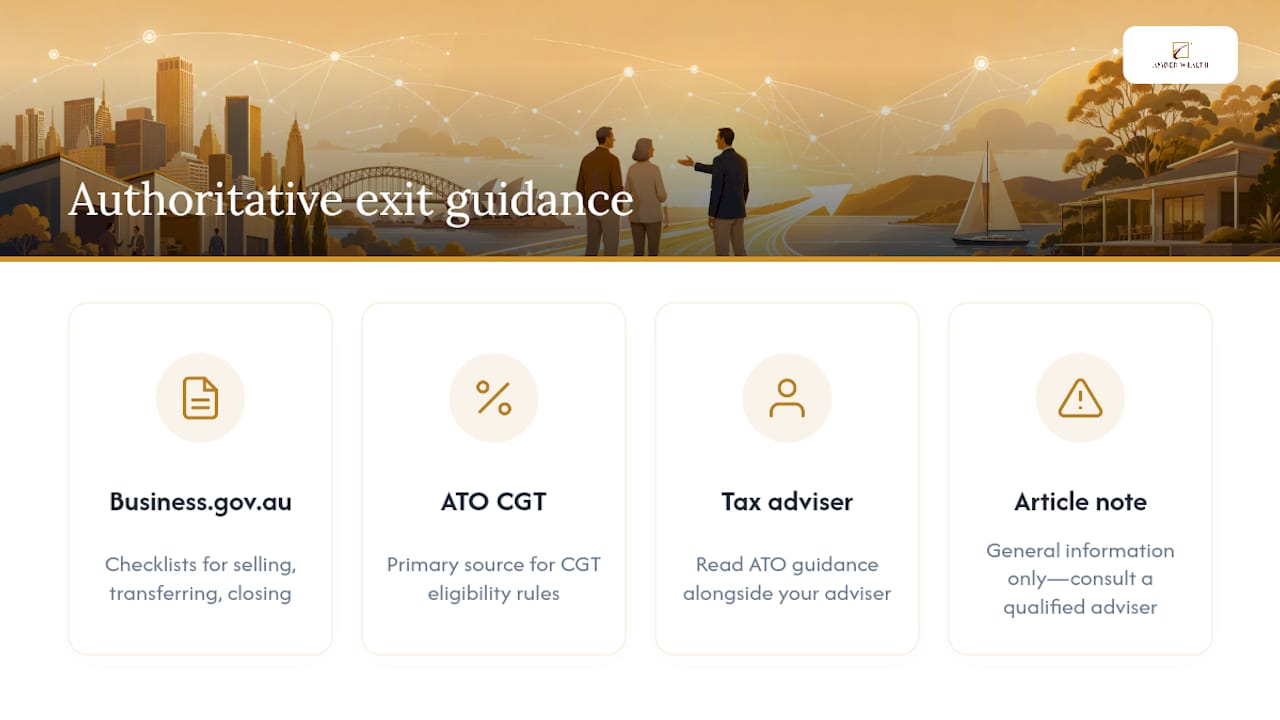
This article is general information, not a substitute for advice from a qualified financial advisor. Consult a qualified financial professional about your own circumstances before acting on anything here.
Sources
FAQ
What is the most effective exit strategy for a business?
There's no single best exit strategy. The right one depends on how much cash you need at close, whether you want the business to continue under family or management control, and your tax position. Third-party sale usually maximises upfront cash, while family succession or an MBO prioritise continuity, often at the cost of a slower payout.
What are the ATO requirements for closing a business?
The ATO requires you to finalise outstanding tax obligations, including BAS and income tax lodgements, before formally deregistering a business, alongside cancelling your ABN and GST registration. Specific requirements depend on your business structure, so it's worth checking the ATO's guidance or speaking with your accountant before you begin the closure process.
What are the five Ds of exit planning?
The five Ds are death, disability, divorce, disagreement and distress, the involuntary triggers that force an unplanned business exit. Exit planning guides flag these as common causes of reactive, low-value exits, which is why a one-page emergency continuity plan is worth writing even if you're not planning to exit for years.
What should an exit plan include?
A solid exit plan includes a baseline valuation, a chosen exit route, a documented timeline of value-building actions, a tax strategy developed with an accountant, and a personal financial plan covering what happens to the proceeds. It should also address governance for partners or family, and a contingency plan for the five Ds.
How does Amber Wealth help with business exit planning?
Amber Wealth focuses on the personal financial side of an exit, including retirement planning, tax modelling, estate alignment and insurance review, working alongside your business broker, accountant and solicitor. Pricing for these services depends on your circumstances and is discussed during a consultation rather than published as a flat rate.
Recommended
- Small business CGT concessions: a practical guide for owners
- A retirement planning checklist for people approaching retirement
- Retirement income strategies that turn savings into a paycheck
This article is general information, not a substitute for advice from a qualified financial advisor. Consult a qualified financial professional about your own circumstances before acting on anything here. General Advice Warning Disclaimer: The information on this website is general information only and is not intended to be a recommendation. We strongly recommend you seek advice from your financial adviser as to whether this information is appropriate to your needs & financial situation.