

Key person insurance is a policy your business owns and pays for, covering a named employee or owner whose death, permanent disability or serious illness would hit the company financially. The payout goes to the business, not the individual, and gets used to replace lost revenue, repay debt or fund a buy-out of a departing owner's share. Most small and medium Australian businesses that rely heavily on one or two people should at least have this conversation with an adviser before assuming it's unnecessary.
TL;DR:
- Most Australian SMEs relying heavily on one or two individuals should consider key person insurance to protect against sudden loss of revenue or increased debt.
- Cover typically responds to death, permanent disability, or critical illness and is owned by the business, with payouts used to stabilize operations or fund buy-outs.
- Proper documentation of the policy's purpose, ownership structure, and alignment with tax classification is crucial to avoid disputes and unexpected tax liabilities later.
- Sum insured often ranges from $500,000 to several million, calculated based on revenue impact, debt, or the value of equity, with premiums affected by the insured person's age, health, and job risk.
- The policy only pays out on insured events, meaning resignations or retirements are not covered, emphasizing the importance of correct risk assessment and documentation upfront.
Table of Contents
- What is key person insurance and how does it work in Australia?
- Who actually counts as a key person in your business?
- What types of cover count as key person insurance?
- Policy purpose and tax treatment: revenue vs capital
- Benefits and common business uses
- How much cover do you actually need, and what drives the cost?
- Setting up a key person policy correctly
- Choosing the right cover: a checklist and the red flags to watch
- Common mistakes we see with key person cover
- What the tax rules really mean for your business
- Get a personal insurance review from a financial planning firm
- Sources
- FAQ
What is key person insurance and how does it work in Australia?
Key person insurance sits on your business's books, not the employee's. The company applies for the policy, pays the premiums, and receives the payout if the insured event happens. The person insured, often called the "life insured", is someone whose absence would cause the business real financial pain: a founder, a top biller, a technical specialist holding client relationships nobody else can replicate.
Cover generally responds to three types of events: death, total and permanent disability (TPD), and trauma or critical illness. Some businesses also structure combined policies that trigger on any of these events, while others hold separate life, TPD and trauma policies with different sums insured for each. Occasionally you'll see monthly benefit structures designed to smooth cashflow over a defined period rather than paying one lump sum, though a lump sum remains far more common in key person arrangements.
Company ownership matters more than most business owners realise at the outset. When the business owns the policy, it controls how the payout gets used and when. There's no dispute about whether the money goes to the employee's family or stays with the company, because the structure settles that question upfront. This is also what separates key person insurance from standard personal life insurance: the beneficiary is the business itself (or, in some lender-driven arrangements, a nominated financial institution), not a spouse or dependant.
The practical effect is straightforward. If your operations director dies suddenly, the company isn't just grieving. It's also facing recruitment costs, a training gap, possibly a stalled project pipeline and nervous clients. A payout arriving within weeks rather than months gives you room to manage all of that without raiding cash reserves or scrambling for an emergency loan. Brokers who specialise in this cover consistently point to that breathing room as the real value, more than the headline sum insured itself.
One thing key person insurance does not do: it doesn't cover someone who resigns, retires, or simply moves on to a competitor. It only pays on the insured events named in the policy, which means voluntary departures sit entirely outside its scope, no matter how damaging they are to the business.
Who actually counts as a key person in your business?
Not every valued employee qualifies as a "key person" for insurance purposes. The test insurers and advisers apply usually comes down to financial contribution and irreplaceability, not job title or seniority alone.
A few markers tend to separate a genuine key person from a merely important one:
- They generate or influence a disproportionate share of revenue, whether through direct sales, client relationships or specialised technical output.
- Their knowledge or relationships are hard to document and transfer, such as a founder who holds most supplier and client contacts personally.
- They've given a personal guarantee on a business loan or lease, meaning their absence could trigger lender conditions or refinancing headaches.
- Replacing them would mean a long, expensive recruitment and training cycle, not a quick internal promotion.
In practice, this covers a fairly predictable list across Australian SMEs: the founder or managing director, a principal salesperson carrying most of the client book, a technical lead whose expertise underpins the product or service, and a CFO or finance director who has personally guaranteed finance facilities. Medical and dental practices often insure the principal practitioner specifically, since patient relationships and referral networks rarely transfer cleanly to a locum.
Insurers will run their own eligibility checks before issuing cover, and this is where owners sometimes get caught out. High-risk occupations, certain hobbies, health history and even specific job duties can attract loadings or exclusions. A construction company insuring a site manager who also does hands-on trade work, for instance, may face a different underwriting outcome than one insuring an office-based project manager. Disclosing the actual duties and responsibilities early, rather than a generic job title, tends to reduce disputes if a claim is ever made.
What types of cover count as key person insurance?
Key person insurance isn't a single product. It's a purpose applied to standard life, TPD and trauma policies, which means the choice of cover type should match the specific risk you're trying to manage.
- Life cover pays a lump sum on death. This is the baseline most businesses start with, since it addresses the most severe and clear-cut event: capital protection when the insured person can no longer contribute at all.
- TPD cover pays out if the insured person becomes totally and permanently disabled and can no longer work in their occupation, or any occupation, depending on the policy definition. This tends to fit businesses worried about long-term incapacity rather than death specifically, particularly where the key person's role is highly physical or highly specialised.
- Trauma (critical illness) cover pays out earlier, on diagnosis of a defined serious illness such as cancer, heart attack or stroke, rather than waiting for death or permanent disability. For a business, this often matters more than people expect: it gives the company cash to stabilise operations while the person is still alive and potentially still connected to the business, rather than only after the worst outcome.
- Income-style arrangements that pay a monthly benefit instead of a lump sum exist but are far less common in a key person context, since businesses generally prefer the flexibility of a lump sum to cover irregular costs like recruitment fees or debt repayment in one hit.
Some businesses combine all three into one policy on a single life insured; others hold separate policies with different sums insured for each risk, which can make sense when the financial exposure to death differs meaningfully from the exposure to trauma. Either way, the exclusions matter as much as the inclusions. Standard exclusions rule out resignation, retirement, redundancy, and in most cases pre-existing conditions not disclosed at application. Read the product disclosure statement rather than the marketing summary before assuming a scenario is covered.
Policy purpose and tax treatment: revenue vs capital
This is the section most business owners skip, and it's the one that causes the most grief later. The Australian Taxation Office treats key person insurance differently depending on whether the policy serves a revenue purpose or a capital purpose, and getting this distinction wrong can mean an unexpected tax bill or a denied deduction.
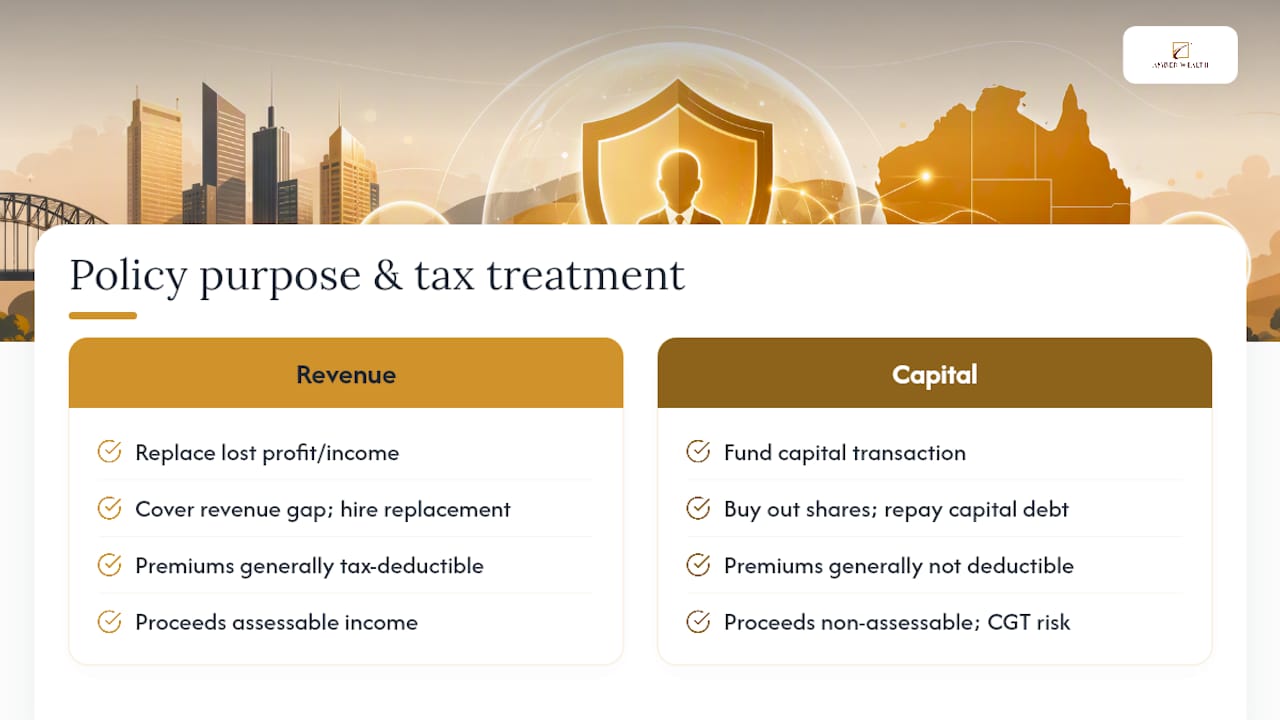
The distinction that changes everything: a revenue-purpose policy exists to replace lost profit or income the business would otherwise have earned. A capital-purpose policy exists to fund a capital transaction, most commonly buying out a deceased or incapacitated owner's share of the business.
A revenue-purpose policy is typically taken out to cover the loss of profits, sales or operational capacity that follows the loss of a key person. Think of a business insuring its top salesperson specifically to cover the revenue gap while a replacement is found and trained. According to ATO guidance summarised by Canstar, premiums on a revenue-purpose policy are generally tax-deductible, and the resulting payout is generally treated as assessable income when it's received.
A capital-purpose policy serves a different function: funding the purchase of a departing owner's equity, repaying a capital debt, or otherwise settling a capital transaction rather than plugging an income gap. A classic example is a two-director company insuring each director so that if one dies, the surviving director's company (or the surviving director personally, depending on structure) has the funds to buy out the deceased's shares from the estate, rather than forcing a fire sale or drawing an unwilling family member into the business. Premiums on a capital-purpose policy are generally not tax-deductible, and the proceeds are generally not treated as assessable income, though capital gains tax consequences can still arise depending on how the shares and proceeds are structured.
The practical complication is that many real-world policies serve both purposes at once, at least in part. A CFO's cover might be partly about replacing lost financial oversight capacity (revenue) and partly about repaying a loan the CFO personally guaranteed (capital). When that happens, advisers commonly recommend allocating and documenting the proportion of premium attributable to each purpose at the time the policy is taken out, not after a claim arrives and the ATO starts asking questions.
Three practical steps protect you here. First, write down the stated purpose of the policy in board minutes or a formal document at the time you buy it, not retrospectively. Second, if the policy is genuinely mixed-purpose, split and document the premium allocation between revenue and capital components. Third, involve your accountant before you claim any deduction or treat any proceeds as assessable or non-assessable, since the ATO's own deduction rules are specific about substantiation, and getting this wrong retrospectively is far harder to fix than getting it right upfront.
Benefits and common business uses
Key person insurance earns its premium in a fairly small number of recurring scenarios, and understanding which one applies to your business shapes how you structure the policy.
- Revenue protection. The most direct use: covering the drop in turnover that follows losing a key salesperson, technical lead or client-facing principal. The payout bridges the gap between the loss occurring and a replacement becoming fully productive, which for a specialised role can realistically take six to twelve months.
- Debt protection. Where a key person has personally guaranteed a business loan, lease or overdraft, their death or incapacity can trigger immediate lender concern about the security behind that facility. A payout structured to repay or reduce that debt keeps the business's banking relationship intact rather than forcing a renegotiation under pressure.
- Buy/sell and equity transfer funding. In multi-owner businesses, key person insurance (structured for a capital purpose) funds the purchase of a departing owner's share, which avoids two common bad outcomes: a forced sale of the business to raise cash, or a surviving family member becoming an unwilling business partner by default.
- Lender and investor reassurance. Banks assessing a loan application to a business with concentrated key person risk will often factor cover into their lending decision. Having the policy in place, and sometimes naming the lender as beneficiary, can genuinely affect the terms you're offered.
The recruitment and training angle deserves a specific mention, because owners consistently underestimate it. Specialist brokers point out that the cost of replacing a key employee rarely stops at a recruiter's fee. It includes months of reduced productivity, onboarding time, and often a period where clients or projects are actively at risk while the new person gets up to speed. Sizing cover on salary alone tends to understate the real exposure.
How much cover do you actually need, and what drives the cost?
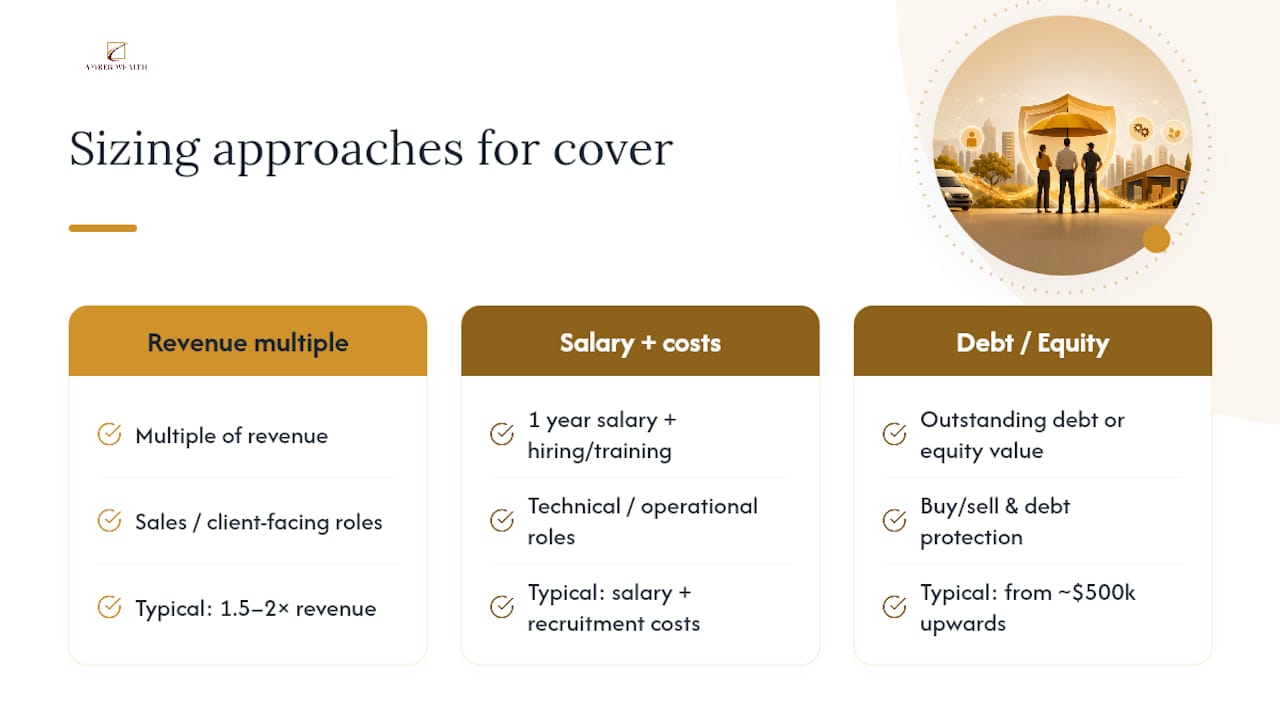
There's no single formula that fits every business, but three sizing approaches cover most situations. The first uses a multiple of the revenue the key person generates or influences, which suits salespeople and client-facing principals whose value is measurable in dollars they bring in. The second uses one year of the person's salary plus estimated recruitment and training costs, which suits technical or operational roles where the loss is about lost capacity rather than lost sales. The third uses outstanding debt or the value of the person's equity stake, which suits debt protection and buy/sell arrangements specifically.
Industry data suggests sums insured for Australian businesses commonly range from around $500,000 upward into the millions, depending on the size of the business and the specific exposure being covered. A sole-director consultancy insuring its founder for debt protection might sit toward the lower end of that range; a multi-partner professional services firm funding a full buy/sell arrangement across several partners will typically need considerably more.
Cost itself is driven by a familiar set of underwriting factors: the insured person's age, health history and smoking status, their occupation and any associated risk loading, the term of the policy, and whether you're bundling life, TPD and trauma into one combined policy or buying them separately. A 40-year-old non-smoking office-based director will attract materially lower premiums than a 55-year-old smoker in a physically demanding trade role, for the same sum insured.
Pro Tip: Don't size cover on salary alone. Broker commentary consistently notes that indirect costs, lost client relationships, training time, stalled projects, push the realistic figure well above a simple salary multiple. Run the numbers with your actual recruitment and onboarding timeline in mind, not a rule of thumb.
Two quick scenarios illustrate the trade-off. A boutique marketing agency insuring its founder for revenue protection might land on 1.5 to 2 times annual revenue attributable to that person, reasoning that a twelve-month recovery period is realistic. A two-partner accounting firm funding a buy/sell agreement will size cover to the current value of each partner's equity stake, reviewed periodically as the business grows. Undersizing this figure is what leads to forced sales later.
Setting up a key person policy correctly
Getting the paperwork right at the start is what makes the difference between a smooth claim and a drawn-out dispute later. A few steps matter more than owners typically expect.
- Pass a formal board or shareholder resolution authorising the policy, naming the life insured and recording the stated purpose (revenue, capital, or a documented split of both).
- Get the insured person's informed consent in writing, since insurers require this and it also protects the business if the arrangement is ever questioned by the person's family or estate.
- Decide ownership structure early: most businesses use straightforward company ownership, though multi-owner buy/sell arrangements sometimes use cross-ownership between the owners themselves rather than the company.
- If a lender is involved, check the loan documents for any requirement to name the lender as beneficiary, or to maintain cover at a specified level for the life of the facility.
- Keep contemporaneous records of the insured person's role, contribution and any personal guarantees, since claim assessments commonly require evidence of the financial impact, not just proof of the insured event itself.
- Review the policy annually, or whenever the business's ownership, revenue or debt structure changes materially, since a sum insured set three years ago rarely still matches the current risk.
Lenders deserve particular attention here. When a loan is guaranteed by a key individual, banks and finance providers frequently make key person insurance a condition of approval, sometimes requiring the facility itself to be named as beneficiary rather than the company. Checking your loan documents before you approach an insurer avoids the awkward situation of buying a policy that doesn't actually satisfy the lender's conditions.
Pro Tip: If a claim ever needs to be made, insurers typically ask for medical reports, a death certificate where relevant, proof of the insured person's role, and evidence of the financial impact on the business, such as revenue records showing the drop after their absence. Finder's guidance on keyman claims makes clear that businesses with weak record-keeping around the insured person's actual contribution face longer, harder claims. Start that documentation habit now, not after something happens.
Choosing the right cover: a checklist and the red flags to watch
Before you sign anything, work through six questions with whoever you're buying cover through, whether that's a broker, an insurer directly, or a financial adviser.
- What loss are you actually protecting against? Define it in dollars: lost revenue, a debt repayment obligation, or the cost of buying out an owner's equity. Vague answers here lead to vague, poorly sized policies.
- Is the policy purpose clearly stated and documented? Revenue, capital or a documented split. This single decision drives the tax outcome, so it needs to be settled and written down before the policy starts, not argued about after a claim.
- Is the sum insured actually adequate? Check it against a genuine estimate of recruitment, training and lost-revenue timelines, not just a salary multiple pulled from a generic template.
- What exclusions and waiting periods apply? Read the PDS for occupation-specific exclusions, pre-existing condition clauses, and any waiting period before trauma cover activates.
- Who owns the policy and who receives the proceeds? Confirm this matches your intended structure, particularly in multi-owner businesses where cross-ownership arrangements need to align with a written buy/sell agreement.
- Is the purpose integrated with your other legal documents? A buy/sell agreement, shareholder agreement or loan covenant should reference the insurance, not sit as a separate, disconnected document.
When you're speaking with an insurer, broker or adviser, a handful of direct questions tend to surface problems early: how does this policy's stated purpose affect our tax treatment, what occupation loadings apply to our specific insured person, how would you handle multiple key people insured under one arrangement, and can you point to a real claim example similar to our situation.
Pro Tip: If anyone selling you a policy can't clearly explain the revenue versus capital tax distinction, or waves it away as "something your accountant will sort out later", treat that as a warning sign. The ATO's own position makes purpose the central question, and any adviser worth using should be able to walk you through it before you sign, not after.
A few red flags are worth naming directly. An insurer or broker who can't articulate the policy's purpose in plain language is a problem. A policy taken out without the insured person's written consent is a legal and practical risk. The absence of a written buy/sell or ownership agreement alongside a capital-purpose policy is a gap that will surface at the worst possible moment, usually during a dispute with a grieving family member. And an unwillingness to discuss tax consequences upfront, rather than deferring everything to "your accountant", suggests the seller hasn't thought through the structuring properly themselves.
Common mistakes we see with key person cover
Owners in Melbourne and around Australia tend to make the same handful of mistakes with key person insurance, and most of them trace back to treating the policy as a simple purchase rather than a structuring decision.
The most frequent one is a mixed-purpose policy with no documentation splitting the revenue and capital components. A business takes out cover intending it to fund both a revenue gap and a future equity buy-out, then never writes down the allocation. Years later, when a claim arrives, there's no paper trail to support the tax position either way, and the accountant is left arguing a position with the ATO that should have been settled at the outset.
The second is policies owned by the individual rather than the company. This sometimes happens because a director takes out personal cover and assumes it will serve a business purpose, without realising that ownership structure changes both the tax treatment and who actually controls the payout. If the business needs the funds but the policy pays a personal beneficiary, the structure has failed at the one moment it needed to work.
The third is missing consent or missing buy/sell documentation. A policy taken out on a business partner without their clear, written agreement, or without a shareholder agreement that actually references the insurance, creates ambiguity precisely when clarity matters most: after a death or serious illness, with family members and business partners all trying to work out what happens next.
The fix for all three is broadly the same: put the purpose in writing when you buy the policy, not afterwards, and bring your accountant and lawyer into the conversation alongside your financial adviser at the start, rather than treating insurance, tax and legal structuring as three separate projects. Business value also changes. A company insured three years ago for $1 million in revenue protection may need a very different figure today if turnover, staff or debt levels have shifted, which is why an annual review matters as much as the initial setup.
What the tax rules really mean for your business
The revenue versus capital distinction isn't a technicality lawyers argue about for fun. It's the single decision that determines whether your premiums are deductible and whether a payout arrives tax-free or as assessable income, and too many businesses buy cover first and think about purpose later, if at all.
Conventional advice tends to treat key person insurance as a product decision: pick a sum insured, pick a term, done. That undersells the real complexity, which is documentation and structuring, not the underlying policy itself. Most standard life, TPD and trauma products work fine as key person cover. What goes wrong is the paperwork around purpose, consent and ownership.
If you take one thing from this article into your next meeting with a broker, accountant or lender, make it this: state the purpose in writing before you buy, and revisit it every time the business's ownership, debt or revenue structure changes. That single habit prevents most of the disputes and tax surprises that show up in this area.
— Adam
Get a personal insurance review from a financial planning firm
If your business depends heavily on one or two people, and you've never had someone actually check whether your cover, ownership structure and documented purpose line up, that gap is worth closing before it becomes expensive. Financial advisers work with business owners and professionals to review existing personal insurance arrangements, including life, TPD and trauma structuring for key person and buy/sell purposes, and to identify where tax treatment or ownership documentation might not match what the business actually needs.

Advice starts with understanding your business's specific exposure, who your key people are, what losing them would cost, and how any existing cover is structured, before recommending changes. Where cover needs adjusting or a policy needs to be put in place for the first time, advisers can help you get a life insurance quote tailored to your situation, and coordinate with your accountant and lawyer on the documentation that protects the tax outcome you're expecting. This article is general information only and doesn't account for your specific circumstances, so speak with a financial adviser before making decisions about your business's insurance structure. If you'd like to start that conversation, book a consultation with a financial adviser.
Sources
For readers who want to check the primary guidance behind this article, the ATO's business deductions guidance sets out how premium deductibility and income assessability work in principle. Canstar's key person insurance explainer covers the revenue versus capital distinction in practical terms, while AJG Australia's broker overview and Finder's keyman insurance guide both offer useful detail on sum insured ranges, lender requirements and claims evidence.
This article is general information, not a substitute for advice from a qualified financial advisor. Consult a qualified financial professional about your own circumstances before acting on anything here.
- Key person insurance explained | Canstar
- Key person insurance | AJG Australia
- Keyman insurance: Protect your business | Finder
- Income and deductions for business | ATO
FAQ
What is key person insurance?
Key person insurance is a policy a business owns and pays for, covering a named employee or owner whose death, TPD or trauma would cause significant financial loss to the company. The business receives the payout, generally used to replace lost revenue, repay debt or fund a buy-out of an owner's share.
What is a keyman insurance policy?
"Keyman insurance" is an older, informal term for exactly the same thing as key person insurance: company-owned life, TPD or trauma cover on a named individual whose loss would financially harm the business. The two terms are used interchangeably in Australia, though "key person" is now the more common industry term.
How is key person insurance taxed in Australia?
Tax treatment depends entirely on the policy's documented purpose. Premiums on a revenue-purpose policy are generally tax-deductible and the payout is generally assessable income, while premiums on a capital-purpose policy are generally not deductible and the proceeds are generally not assessable, though CGT may still apply.
How much does key person insurance cost?
Cost depends on the insured person's age, health, occupation and the sum insured chosen, so there's no single figure that applies across the board. Sums insured in Australia commonly start from around $500,000 and scale up depending on the business's revenue, debt and equity exposure.
Who should be insured as a key person in a small business?
Typically the founder or managing director, a top salesperson carrying most client relationships, a technical specialist whose knowledge is hard to replace, or a director who has personally guaranteed business finance. The common thread is financial contribution and irreplaceability, not job title alone.
Does key person insurance cover an employee who resigns?
No. Key person insurance only pays out on insured events named in the policy, such as death, TPD or trauma. Voluntary departures like resignation or retirement fall outside the cover entirely.
Recommended
- Avoid the CGT Trap: Buy Sell Insurance for Australian Business Owners
- Small business CGT concessions: a practical guide for owners
- Avoid Trustee and Tax Pitfalls with Testamentary Trusts in Australia
This article is general information, not a substitute for advice from a qualified financial advisor. Consult a qualified financial professional about your own circumstances before acting on anything here. General Advice Warning Disclaimer: The information on this website is general information only and is not intended to be a recommendation. We strongly recommend you seek advice from your financial adviser as to whether this information is appropriate to your needs & financial situation.