

Yes, an SMSF can still hold property. But from 10 August 2026, new borrowing arrangements used to buy real property are limited to business real property, which shuts the door on new leveraged residential purchases. Outright purchases without borrowing remain available under the usual SMSF rules, and existing arrangements set up before that date generally continue as they were.
TL;DR:
- From August 2026, new borrowing arrangements in SMSFs will be limited to business real property, excluding residential property purchases through leverage.
- The 5% in-house asset rule restricts related-party investments and loans, requiring trustees to have detailed documentation and correction plans if exceeded.
- Buying property via an LRBA requires careful sequencing, including setting up the bare trust before contracts and ensuring property use meets business real property criteria.
- Costs for SMSF property include setup fees, stamp duty, ongoing administration, and costly compliance obligations, making it suitable only for larger, well-funded funds.
- Property in an SMSF offers tax benefits but entails high ongoing costs, liquidity risks, and strict adherence to rules, especially for retail investors targeting residential assets.
Table of Contents
- Is SMSF property investment right for your fund?
- What SMSF property rules must trustees follow?
- How do LRBAs work, and what changes from 10 August 2026?
- What does SMSF property investment actually cost?
- What are the pros, cons and risks of SMSF property?
- How do you set up property in an SMSF correctly?
- Amber Wealth's view: who actually benefits from this strategy?
- What happens when you sell property held in an SMSF?
- How do trustees manage tenants and maintenance in an SMSF?
- The conventional wisdom on SMSF property is outdated
- How Amber Wealth can help with SMSF property decisions
- Sources
- FAQ
Is SMSF property investment right for your fund?
Property inside an SMSF suits some funds and punishes others. Before you get into the legal detail, run a quick gut check on scale, intent and appetite for admin.
- Fund balance: most advisers see limited recourse borrowing arrangements (LRBAs) become genuinely cost-effective only once a fund holds a meaningful deposit plus a liquidity buffer, not the bare minimum.
- Borrowing intent: are you planning to gear the purchase, or buy outright? This single decision now determines whether the 2026 rules even apply to you.
- Who you are: business owners buying their own commercial premises through the fund sit in a very different position to a retail investor eyeing a rental house.
- Admin appetite: property inside super means annual valuations, a specific audit trail and ongoing paperwork that a straightforward share portfolio doesn't demand.
If two or more of those points make you uneasy, that's worth sitting with before you go further.
What SMSF property rules must trustees follow?
Every SMSF exists for one reason under the law: to fund your retirement, not to solve today's problems. That's the sole purpose test under section 62 of the SIS Act, and it sits underneath every property decision a fund makes.
Three rules do most of the work in practice:
- The sole purpose test. The fund's property investment must be aimed at retirement benefits. A member or relative living rent free in a fund-owned house, or a business owner using fund property without paying market rent, breaches this test outright.
- Related-party acquisition restrictions. SMSFs generally cannot buy residential property from a member, relative or related entity. The exception is business real property, which can be acquired from a related party at market value.
- The in-house asset 5% rule. Loans to, or investments in, related parties are capped at 5% of total fund assets. Exceed it, and trustees must prepare a written plan to bring the fund back under the threshold, typically within the following income year.
Contraventions carry real teeth. The Australian Taxation Office can issue administrative penalties, order rectification, or in serious cases declare a fund non-complying, which strips concessional tax treatment and can trigger tax at the highest marginal rate on the fund's assets.
Pro Tip: Document market rent and arm's-length terms in writing before a related party ever sets foot on fund property, even for something as small as storage use. Verbal arrangements are the single most common trigger for an audit finding.
How do LRBAs work, and what changes from 10 August 2026?
A limited recourse borrowing arrangement lets an SMSF borrow to buy a single acquirable asset, with the lender's recourse limited to that asset if the loan defaults. The structure requires a separate bare trust (sometimes called a holding trust) with its own corporate trustee, which legally holds the property while the SMSF retains beneficial ownership. Grant Thornton's guide to LRBAs notes trustees cannot use an existing fund asset as loan security, and borrowed funds cannot be used to substantially improve the asset once acquired.
The big shift: from 10 August 2026, any new LRBA used to acquire real property must involve property that meets the legal definition of business real property at the time the arrangement is entered into. Ordinary residential property, geared through a new LRBA, is off the table.
- Business real property is defined by actual use, not zoning or appearance. A house used wholly and exclusively in a business can qualify even though it looks residential.
- Binding contracts exchanged before 10 August 2026 retain transitional protection, so deals already locked in aren't caught by the new restriction.
- Refinancing an existing residential LRBA generally doesn't require the new property to satisfy the business real property test, though the specifics depend on how the arrangement is documented.
Lenders willing to fund LRBAs typically price them above standard investment loans and expect a lower loan-to-value ratio than you'd see on a personal mortgage. If your property use is borderline (a home office attached to a trade business, for instance), read our SMSF borrowing rules guide before you commit to a contract.
What does SMSF property investment actually cost?
Property in an SMSF isn't a cheap entry point, and the ongoing bill is where most trustees underestimate the commitment.
Upfront costs typically include:
- Legal fees to draft or amend the trust deed and set up the bare trust
- Stamp duty on the property purchase (state-based, and it applies regardless of the SMSF structure)
- An independent property valuation, required both at purchase and periodically afterwards
- Loan establishment fees if you're borrowing
Ongoing running costs stack up every year: SMSF administration and accounting, the mandatory annual audit, landlord insurance, council rates, and property management fees if you're not self-managing tenants. MoneySmart notes that these combined costs often run into several thousand dollars annually, before loan interest is factored in.
On tax, this is where property inside super earns its keep for the right fund. Rental income and capital gains are taxed at 15% in accumulation phase, dropping to 0% once the fund moves into pension phase and the asset is supporting a retirement income stream, subject to the transfer balance cap.
As a rough guide, advisers generally consider SMSF property most cost-effective once a fund is large enough to absorb setup costs, loan servicing and a liquidity buffer without straining the fund's ability to pay member benefits or the annual audit and admin bill. Below that scale, the fixed costs eat too much of the return. Our superannuation tax rates guide breaks down how accumulation and pension-phase tax treatment interact with contribution caps.
What are the pros, cons and risks of SMSF property?
The upside is real, but it comes bundled with obligations that don't show up in a glossy pitch deck.
Benefits:
- Concessional tax in accumulation phase, and potentially 0% tax on rental income and capital gains once in pension phase
- Diversification away from listed shares and managed funds
- Business owners can hold their own commercial premises inside the fund and pay rent to themselves at market rates
- Direct control over the specific asset, rather than a pooled fund's decisions
Disadvantages and risks:
- Heavy compliance burden: annual audits, valuations, and detailed trustee documentation
- Liquidity risk: property can't be partially sold to pay a member's benefit or a pension payment
- Higher borrowing costs and stricter lending criteria than standard investment loans
- Non-arm's-length income risk if rent, purchase price or lease terms aren't at market value
- Getting the LRBA sequencing or documentation wrong, which invites an audit finding
Business owners buying their own trading premises through their fund tend to get the cleanest value from this strategy. Retail investors chasing a rental house purely for capital growth face a much harder cost-benefit case, particularly after the 2026 borrowing restriction.
How do you set up property in an SMSF correctly?
Sequencing matters more here than in almost any other super strategy. Get the order wrong, and you can invalidate the entire arrangement.
- Check the trust deed and investment strategy. Confirm both explicitly permit property investment and borrowing before you go house hunting.
- Get an independent valuation and keep documentation proving the purchase price reflects market value, especially important for any related-party business real property deal.
- Set up the bare trust and its corporate trustee first if you're borrowing. This has to happen before contracts are exchanged, not after.
- Secure lender pre-approval and confirm the fund's cash flow can service loan repayments alongside member benefit obligations.
- Engage your SMSF accountant and solicitor early, and book the annual audit and appropriate insurance before settlement, not as an afterthought.
Pro Tip: Never sign a contract of sale before the bare trust deed is executed. Retrospectively trying to fit an already-purchased asset into an LRBA structure is one of the fastest ways to breach the rules, and it can't be fixed after the fact. For a broader walkthrough of establishing the fund itself, see our guide on how to start an SMSF.
Amber Wealth's view: who actually benefits from this strategy?
In our experience advising trustees, SMSF property investment tends to suit business owners holding business real property, or funds with enough scale to absorb setup and running costs comfortably. It suits fewer small funds than the marketing around it suggests.
The mistakes we see most often: holding trusts set up too late, thin documentation on related-party arrangements, and trustees underestimating annual running costs until the audit bill lands. None of these are fatal if caught early, but they're expensive to fix after settlement.
This is general information only. Whether SMSF property fits your circumstances depends on your fund's balance, your other assets and your retirement timeline, so speak with a qualified financial adviser, SMSF accountant and solicitor before acting.
What happens when you sell property held in an SMSF?
Selling property out of an SMSF isn't the same transaction as selling a personally-owned investment property, and timing changes the tax outcome significantly.
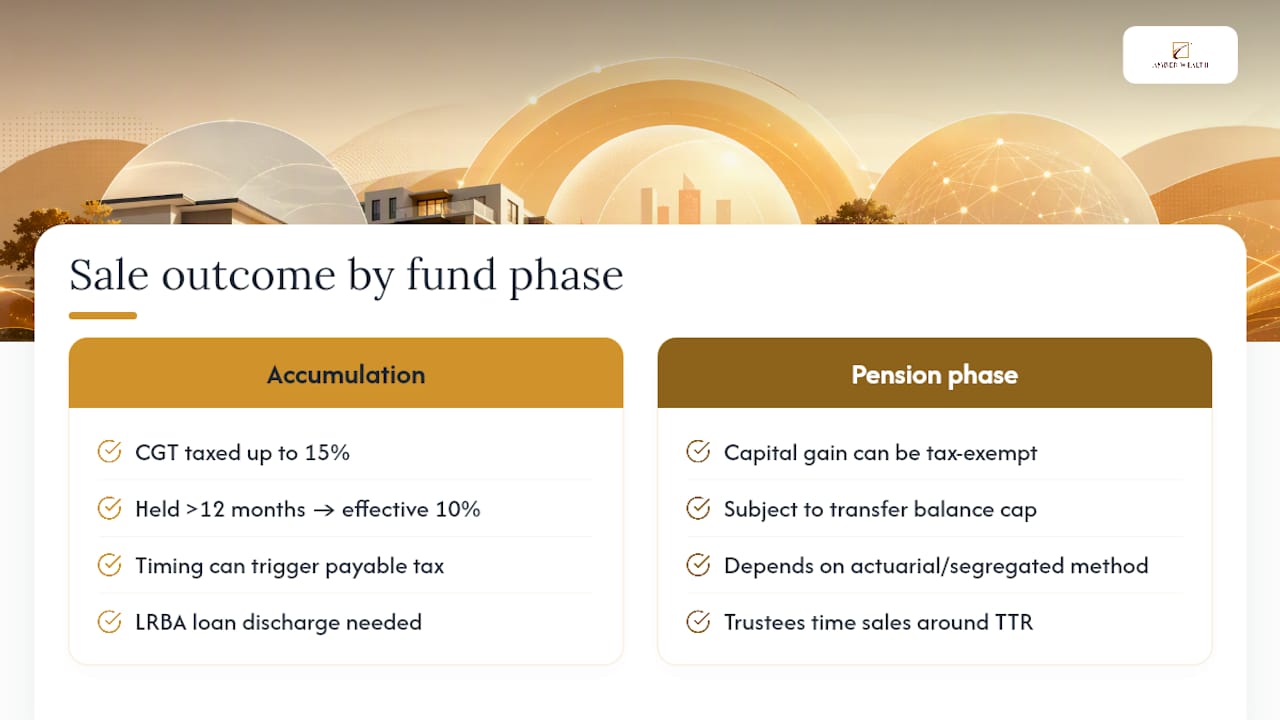
If the fund is still in accumulation phase when the property sells, the capital gain is taxed at up to 15%, reduced to an effective 10% if the fund held the asset for more than 12 months, thanks to the one-third CGT discount available to complying super funds. If the same asset is sold while it's fully supporting a pension in retirement phase, the capital gain can be exempt from tax altogether, subject to the transfer balance cap and how the actuarial or segregated method applies to the fund's assets.
That timing gap is why many trustees plan a sale deliberately around their transition to retirement, rather than reacting to market conditions. Selling a growth asset just before moving into pension phase can mean paying tax that would have been avoided by waiting, while selling too late risks missing a strong market or needing liquidity sooner than expected.
Practical exit considerations trustees often overlook include existing loan discharge if the property still carries an LRBA, the time needed to sell an illiquid asset if a member's benefit falls due, and whether the sale proceeds need to be reinvested to satisfy the fund's investment strategy. Property is not a same-day liquidity source, and a fund heavily weighted to one asset can find itself unable to meet a pension payment or lump sum request on the timeline a member needs.
How do trustees manage tenants and maintenance in an SMSF?
Running an SMSF-owned property as a landlord carries the same day-to-day realities as any rental, plus a layer of compliance that personal property doesn't have.
Lease terms and rent must sit at arm's length and reflect market rates, documented in a proper lease agreement, even when the tenant is unrelated. If a related party or fund member ever occupies or uses the property, the arrangement has to be commercial in every respect, or it risks breaching the sole purpose test outlined earlier. Many trustees engage a professional property manager specifically because it creates a clean paper trail of market rent and formal lease terms, which auditors look for every year.
Maintenance and capital works need careful handling too. Routine repairs can generally be paid from fund cash flow, but borrowed money under an LRBA cannot fund improvements that go beyond simple repairs, since the asset must remain the same "single acquirable asset" the loan was secured against. Trustees planning a renovation should fund it from fund cash reserves or additional contributions, not the existing loan facility, and confirm the distinction with their accountant before work starts. If the property might later convert to business use to satisfy the 2026 business real property test, checking local planning and zoning requirements early avoids costly surprises. A resource like this planning approvals guide is a useful primer on how local council rules intersect with property use changes.
The conventional wisdom on SMSF property is outdated
Most of what's written about SMSF property investment still treats it as a universal wealth-building tool for anyone with a decent super balance. That was arguably fair a decade ago. It isn't anymore.
The 2026 LRBA restriction doesn't just tweak the rules, it recentres the entire strategy around business owners who can genuinely use business real property, and away from retail investors who were using SMSF borrowing as a backdoor into geared residential property. That's a meaningful shift in who this strategy actually serves, and I don't think enough commentary has caught up with it.
What gets underweighted in most guides is liquidity. Trustees fixate on tax savings in pension phase and underestimate how badly an illiquid asset can constrain a fund when a member needs to draw a benefit. My advice: model the fund's cash flow under a stress scenario, not just the best case, before you commit to a purchase. Get the compliance detail right first. The tax advantages only matter if the fund survives long enough to use them.
— Adam
How Amber Wealth can help with SMSF property decisions
Weighing up SMSF property investment against the 2026 changes takes more than a checklist. It takes someone who can look at your fund's actual balance, your business structure and your retirement timeline, and tell you honestly whether the numbers stack up.

Amber Wealth provides SMSF and superannuation advice for business owners and pre-retirees working through exactly this decision, alongside broader retirement planning and property advocacy support if you need help with valuations, due diligence or negotiation once you've decided property is the right fit. If you're weighing a purchase or want a second opinion on an existing structure, consider booking a consultation to talk through your fund's specific position. This article is general information only and doesn't take your personal circumstances into account, so personalised advice is worth getting before you sign anything.
This article is general information, not a substitute for advice from a qualified financial advisor. Consult a qualified financial professional about your own circumstances before acting on anything here.
Sources
- SMSF compliance and penalties — ATO
- SMSFs and property — MoneySmart
- SMSF limited recourse borrowing arrangements — Grant Thornton Australia
FAQ
What is the 5% SMSF rule?
The 5% rule caps in-house assets, including loans to or investments in related parties, at 5% of total fund assets. If a fund exceeds it, trustees must prepare a written plan to reduce the excess, typically within the following income year.
What are the new SMSF rules from 10 August 2026?
New LRBAs used to buy real property must acquire business real property from that date onward. Ordinary residential property can no longer be purchased using a new borrowing arrangement, though binding contracts signed before 10 August 2026 keep transitional protection.
How do you avoid capital gains tax on SMSF property?
Selling SMSF property while it fully supports a pension in retirement phase can make the capital gain exempt from tax, subject to the transfer balance cap. Selling in accumulation phase after holding the asset over 12 months still attracts tax, reduced to an effective 10% via the CGT discount.
What are the disadvantages of an SMSF holding property?
The main disadvantages are the compliance burden of annual audits and valuations, liquidity risk if a member needs a benefit paid, and higher borrowing costs than standard investment loans. Getting LRBA documentation or sequencing wrong can also trigger a compliance breach.
Recommended
- SMSF Pension Setup: Australia 2026 Checklist for TBAR, $2M Cap
- How to start an SMSF: your step-by-step guide
- Small business CGT concessions: a practical guide for owners
This article is general information, not a substitute for advice from a qualified financial advisor. Consult a qualified financial professional about your own circumstances before acting on anything here. General Advice Warning Disclaimer: The information on this website is general information only and is not intended to be a recommendation. We strongly recommend you seek advice from your financial adviser as to whether this information is appropriate to your needs & financial situation.