

Yes, you can split certain super contributions with your spouse. The maximum is generally the lesser of most of that year's taxed splittable contributions or your concessional contributions cap. Your spouse must be under 60, or 60 to 65 and not retired. You apply through your fund, not the ATO, and timing matters more than most people realise.
TL;DR:
- You can split up to 85% of taxed concessional contributions or your concessional cap for the year, whichever is lower, with your spouse before June 30.
- The receiving spouse must be under age 60 or between 60 and 65 and not retired, with age and employment status restrictions applying.
- Contribution splitting involves transferring already taxed contributions and does not create new tax offsets or reduce your own contribution cap.
- It is essential to submit the correct forms, lodge notices beforehand, and verify fund rules to avoid delays or rejections during the application process.
- Splitting benefits mainly balancing super balances and preserving insurance, but is best used as part of a broader retirement strategy rather than as a standalone tax minimization tool.
Table of Contents
- What is super contribution splitting?
- Who can receive split contributions?
- How much can you split?
- When and how do you apply?
- Which contributions can and can't be split?
- What are the real benefits of splitting super with a spouse?
- What trips people up: trustee rules and application pitfalls
- How does divorce or separation affect a contribution split?
- What does the process actually look like from start to finish?
- What mistakes should you watch for, and how do you fix them?
- How does splitting fit with salary sacrifice and other super strategies?
- Splitting comes up most often with couples where one partner took years out of the workforce and the other kept contributing steadily. Balancing accounts here can preserve insurance cover that would otherwise lapse, and occasionally opens earlier access to super for the lower-balance partner.
- How Amber Wealth can help with super contribution splitting
- Sources
- FAQ
What is super contribution splitting?
Contribution splitting is a rollover. You ask your fund to move a portion of your concessional (before tax) contributions from your account into your spouse's super account, in the same financial year those contributions were originally taxed and reported.
That is a different mechanism to a spouse contribution, where you make an after tax payment directly into your partner's super and potentially claim a tax offset of up to $540. Splitting moves money that already exists in your account; a spouse contribution adds new money to theirs.
- Splitting transfers already-taxed concessional contributions between super accounts.
- Spouse contributions inject fresh, after tax money and can trigger a tax offset.
- The split amount is still counted against the contributing spouse's concessional cap and tax reporting, not the receiving spouse's.
Confusing the two is common, and it matters for planning. If your goal is a tax offset for helping a lower-earning partner, you want a spouse contribution, not a split.
Who can receive split contributions?
Eligibility sits entirely with the receiving spouse, not the person doing the splitting. The ATO sets three firm conditions:
- The receiving spouse must be under age 60, or
- Aged 60 to 65 and not yet retired, and
- Not 65 or older at all, regardless of work status.
Preservation age becomes relevant here because it underpins the "not retired" test for the 60 to 65 bracket. If your spouse has already met a condition of release and declared retirement, a split is not available to them even if they are still under 65.
Relationship status also matters. The ATO's definition of spouse includes de facto partners, and most funds will ask for evidence of the relationship along with standard identification. Rules can vary slightly by fund, so it is worth checking your specific trustee's requirements before you start the paperwork rather than after.
How much can you split?
The limit is whichever is lower: 85% of your taxed splittable contributions for the year, or your concessional contributions cap for that same year. Most people never bump against the second figure because 85% of a typical year's employer and salary sacrifice contributions sits comfortably inside the cap.
Members of certain public sector defined benefit schemes deal with untaxed splittable contributions instead, where different percentages and rules apply because that tax has not yet been paid.
Applying to split still means the full original contribution counts against your own cap, not your spouse's. Splitting does not create extra headroom. It reallocates money you have already contributed.
- The 85% rule applies to taxed splittable employer and salary sacrifice contributions.
- Personal deductible contributions are splittable too, once a valid Notice of intent has been lodged.
- Carry forward unused concessional cap amounts (available if your total super balance was under the relevant threshold on 30 June the year before) can increase the pool you are entitled to contribute and therefore split, but they do not change the 85% ceiling itself.
When and how do you apply?
Timing catches more people out than any other part of this process. You generally apply to split contributions in the financial year after the year the contributions were made, running from 1 July to 30 June. Contributions made in the 2025-26 year, for example, are typically split during the 2026-27 financial year.
There is one exception. If you are withdrawing or rolling over your entire super balance before 30 June, you can apply to split that same year's contributions immediately, rather than waiting twelve months.
- Confirm your fund actually offers contribution splitting and check its Product Disclosure Statement for fees or minimum balance rules.
- Get your spouse's fund details, member number and proof of identity ready.
- If any of the contributions you want to split include personal deductible contributions, lodge your Notice of intent to claim a deduction (NAT 71121) with your fund first.
- Complete the ATO's Superannuation contributions splitting application (NAT 15237), or your fund's equivalent form.
- Submit the completed form to your own fund, not the ATO, and keep a copy for your records.
- Follow up within a couple of weeks to confirm the fund has processed it and the amount has landed in your spouse's account.
Pro Tip: Send the Notice of intent and the splitting application together, but check with your fund which one they want processed first. Some trustees will reject a splitting application outright if the deduction notice has not already been acknowledged.
Which contributions can and can't be split?
Not every dollar in your super account is splittable. The ATO draws a clear line between contributions that qualify and those that never will, and the list of exclusions catches out more people than the eligible list ever does.
Contributions you can split:
- Employer superannuation guarantee (SG) contributions.
- Salary sacrifice contributions.
- Personal contributions you intend to claim as a tax deduction, once a valid Notice of intent has been lodged.
- Certain assessable amounts allocated from a reserve, where a fund permits it.
Contributions you cannot split:
- Non-deductible personal contributions.
- Spouse contributions received from your partner.
- Government co-contributions.
- Downsizer contributions or First Home Super Saver Scheme amounts.
- Transfers from foreign super funds.
- Any contribution that has already been split once.
Public sector members in untaxed schemes should expect their fund to apply a different calculation for splittable amounts, reflecting the fact that the 15% contributions tax has not yet been paid inside the fund. Always confirm the specifics with your scheme rather than assuming standard APRA fund rules apply.
What are the real benefits of splitting super with a spouse?
Splitting is a balancing tool, not a tax minimisation trick. The genuine planning reasons people use it usually come down to three things:
- Evening out balances between partners, particularly where one has taken time out of the workforce, so both can access preservation age and Age Pension thresholds on more comparable terms.
- Preserving insurance cover held inside a spouse's super account that might otherwise lapse if their balance drops too low or contributions stop.
- Improving flexibility around retirement timing, since a spouse with a healthier balance may be able to access their super, or reduce work hours, earlier than they otherwise could.
What splitting does not do is reduce your own concessional cap usage or create any new tax-free contribution room. The ATO's own guidance is explicit that splitting must be integrated into a wider retirement and Age Pension strategy rather than used as a standalone tax play.
Pro Tip: If your real goal is simply supporting a lower-balance spouse rather than balancing two similar accounts, a direct spouse contribution with its tax offset may achieve more than a split ever will.
What trips people up: trustee rules and application pitfalls
Contribution splitting is not automatic. Trustees have discretion over whether to offer it at all, and many attach their own conditions, fees, or minimum remaining balance requirements. Some funds, as REST's own splitting guidance shows, spell out minimum split amounts and required documentation before an application will even be processed.
The most common errors advisers see:
- Applying for a split before the Notice of intent to claim a deduction has been lodged and acknowledged, which can invalidate the whole application.
- Applying more than once in the same financial year for the same contributions.
- Getting a spouse's member number or fund ABN wrong when the split is going to a different fund.
- Not checking a minimum balance requirement, then having the request rejected outright.
Pro Tip: Use SuperFundLookup to verify your spouse's fund ABN and details before submitting anything. A single transposed digit is enough to delay a transfer by weeks.
How does divorce or separation affect a contribution split?
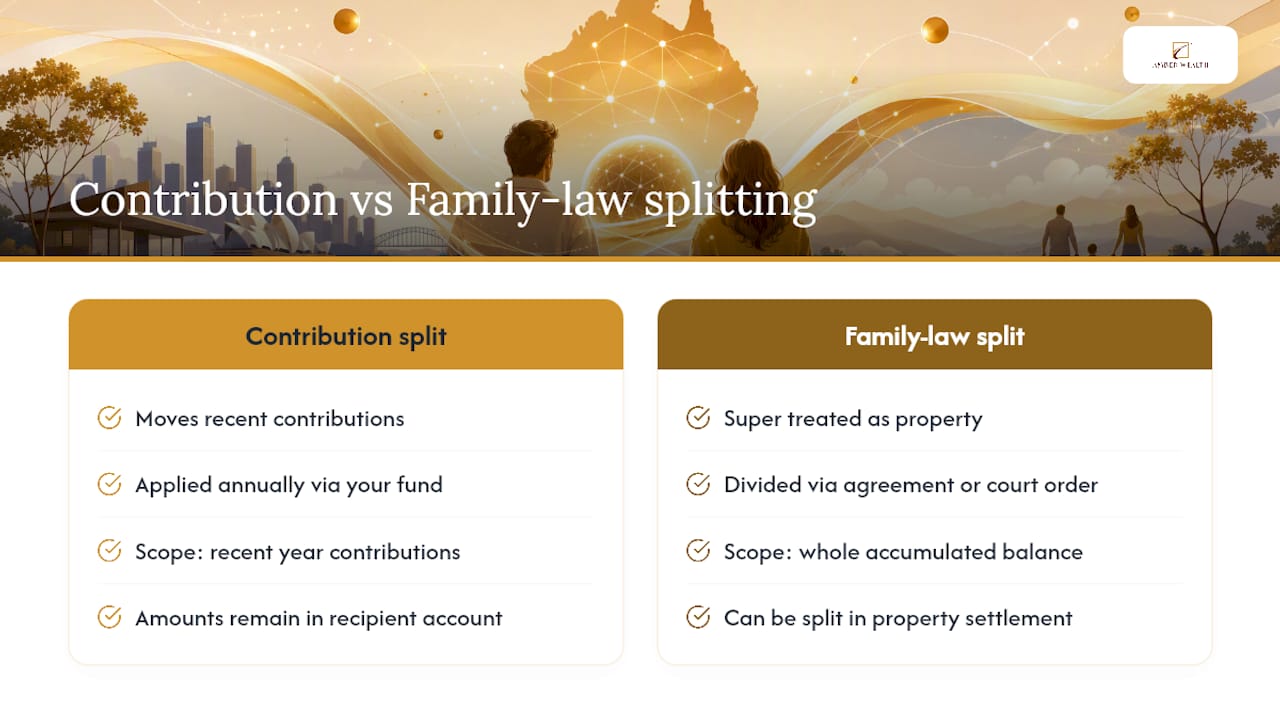
Once a marriage or de facto relationship ends, contribution splitting as a forward planning tool generally stops being relevant between former partners, and family law takes over instead. Superannuation is treated as property under Australian family law, which means it can be divided as part of a property settlement through a superannuation agreement or a court order, separately from the ATO's contribution splitting rules.
It is worth being clear about the distinction. Contribution splitting under tax law moves recent contributions between two spouses who remain together, applied annually through your fund. Family law splitting divides an existing super balance as part of separating finances, and can apply to the entire accumulated balance built over a relationship, not just one year's contributions.
If you split contributions with a spouse in earlier years and later separate, those amounts remain in the receiving spouse's account as their own super. They are not automatically reversed or clawed back. Any subsequent settlement will look at each person's total super balance, however it accumulated, rather than trying to unwind historical splits.
If separation is on the horizon, pause any planned contribution split until you understand how it interacts with a likely property settlement. Splitting contributions into a spouse's account shortly before separation could work against you financially, and family lawyers routinely scrutinise the timing of transfers made close to a relationship breakdown. This is a genuine case where general information stops being enough. Specific legal and financial advice tailored to your separation is essential before any further contributions move between accounts.
What does the process actually look like from start to finish?
Most people underestimate how long contribution splitting realistically takes once you count the waiting periods built into the rules, not just the paperwork itself.
Year one: Contributions are made throughout the financial year through salary sacrifice, employer SG payments, or personal contributions you intend to deduct. Your fund reports these against your concessional cap as usual. Nothing about the eventual split happens yet.
1 July onward, year two: The financial year in which those contributions were made has now closed, and you become eligible to apply to split them. This is the window most people forget exists until their accountant mentions it at tax time.
Before applying, if relevant: Lodge your Notice of intent to claim a deduction (NAT 71121) for any personal contributions, and wait for your fund to acknowledge it in writing. Skipping this step, or applying for the split first, is the single most common reason applications bounce back.
Application submission: Complete NAT 15237 or your fund's own version, listing the exact contribution amounts and your spouse's fund and member details. Submit it directly to your own fund.
Processing: Funds vary in turnaround, but most process a valid, complete application within a few weeks. Delays usually trace back to missing identification, an unacknowledged deduction notice, or a mismatched spouse account number.
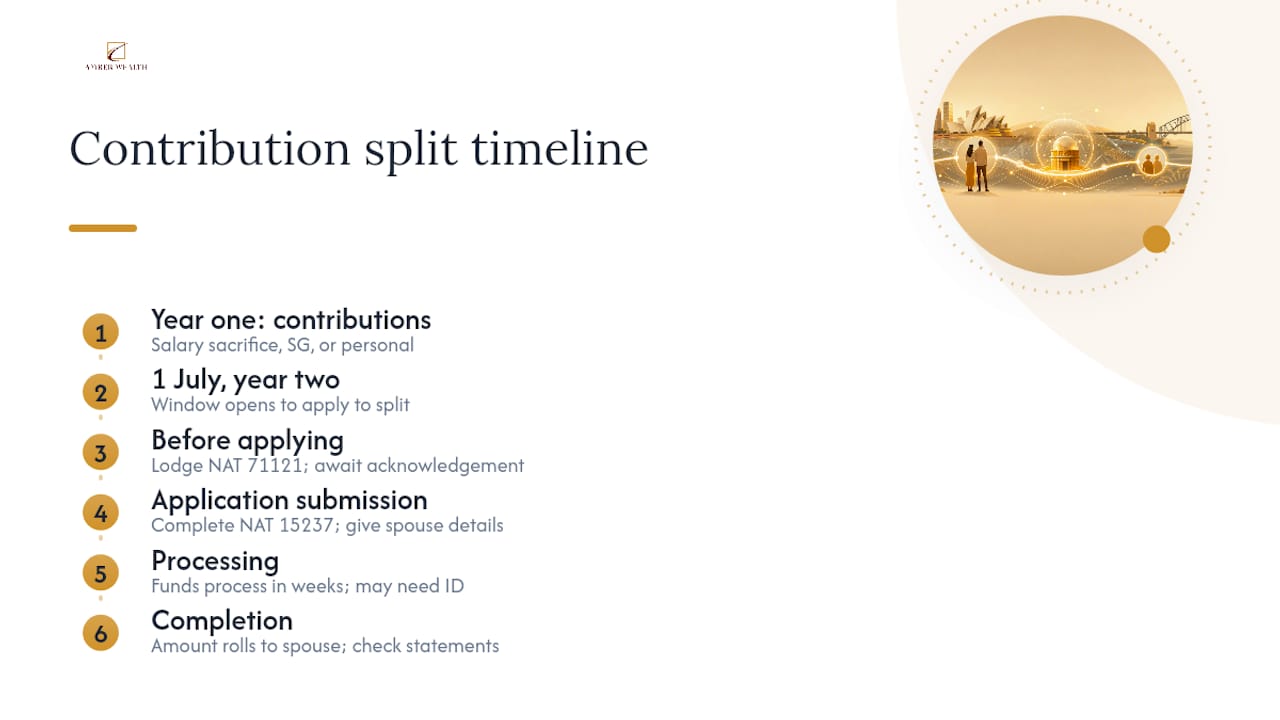
Completion: The nominated amount rolls into your spouse's account as a rollover, not a new contribution, and does not count against their own cap. Confirm the transfer on both members' next statements.
What mistakes should you watch for, and how do you fix them?
Most rejected or delayed applications trace back to a handful of repeat offenders, and nearly all of them are avoidable with a five minute check beforehand.
Missing the annual window. If you meant to split last year's contributions and the financial year has already turned over twice, you have missed the opportunity entirely for that contribution year. There is no retrospective fix beyond the full withdrawal or rollover exception, and that only helps if it applies to your specific situation.
Lodging the split before the deduction notice. If you intended to claim a personal contribution as a deduction, your fund needs to process and acknowledge that Notice of intent first. Applying for the split beforehand is one of the most frequent reasons trustees reject a request outright.
Assuming every fund offers splitting. It is not universal. If your fund does not offer it, your only real fix is confirming that directly with them, since no workaround exists within that fund.
Getting spouse details wrong. An incorrect fund ABN or member number does not just delay a transfer, it can send it to the wrong place entirely if it slips through review. Double check every number against the actual account, not from memory.
Splitting an already split contribution. Once an amount has been split, it cannot be split again. If you are unsure what has already moved, ask your fund for a full contribution history before applying.
How does splitting fit with salary sacrifice and other super strategies?
Contribution splitting rarely works in isolation. It sits alongside, not instead of, the other levers most pre-retirees are already pulling.
Salary sacrifice is the most natural pairing. Salary sacrificed amounts are taxed splittable contributions, meaning whatever you divert from your pre-tax salary into super this year becomes eligible to split with your spouse from 1 July the following year. Many people build a salary sacrifice strategy specifically with an eye to balancing accounts down the track through splitting, rather than treating the two as separate decisions.
Non-concessional (after tax) contributions sit outside this system altogether. They cannot be split under these rules, full stop. If your goal is boosting a spouse's balance with after tax money, a spouse contribution achieves that directly, and may also earn you a tax offset that splitting never provides.
Carry-forward concessional contributions interact with splitting indirectly. Using carry-forward room to make a larger deductible contribution in a given year increases the pool of taxed splittable contributions available the following year, within the usual 85% ceiling.
The strategies that tend to work best combine these tools deliberately: salary sacrificing to build contributions, using carry-forward room where eligible, then splitting a portion annually to keep both partners' balances tracking toward comparable retirement outcomes, rather than one account growing while the other stalls.
Splitting comes up most often with couples where one partner took years out of the workforce and the other kept contributing steadily. Balancing accounts here can preserve insurance cover that would otherwise lapse, and occasionally opens earlier access to super for the lower-balance partner.
It rarely stands alone as a strategy though. It only earns its place inside a wider retirement and Age Pension plan, checked against fund rules and current caps. This is general information, not personal advice. Before your next appointment, gather recent super statements, a summary of this year's contributions and both partners' fund details, so a tailored review can move quickly.
How Amber Wealth can help with super contribution splitting
Working out whether splitting genuinely suits your situation means weighing fund rules, caps, Age Pension tests and your broader retirement timeline together, not in isolation. Amber Wealth's superannuation advice service reviews your contribution history and fund rules against your actual retirement goals, rather than applying a one-size approach to every couple.

If retirement timing, Age Pension eligibility or insurance cover inside super are part of the picture, our retirement planning advice looks at the whole strategy, not just the split itself. You can also run your own numbers first using the Amber Wealth superannuation calculator to see how balancing contributions might shift projected outcomes for you and your partner. Book a complimentary consultation to talk through your specific fund rules and caps before you submit anything.
This is general information only and does not take into account your personal circumstances, objectives or financial situation.
This article is general information, not a substitute for advice from a qualified financial advisor. Consult a qualified financial professional about your own circumstances before acting on anything here.
Sources
FAQ
What are the rules for superannuation contribution splitting?
You can split up to 85% of taxed splittable contributions, or your concessional cap for the year, whichever is lower. The receiving spouse must be under 60, or 60 to 65 and not retired, and applications go to your fund in the financial year after the contributions were made.
What is the concessional contributions cap I should know for splitting?
Concessional cap amounts change periodically, so confirm the current year's figure directly with the ATO or your fund before relying on it, since split amounts are still measured against whatever your personal cap is for that year.
Why split super contributions with a spouse?
Couples typically use splitting to balance retirement account sizes, particularly after one partner has spent time out of paid work, and to help preserve insurance cover attached to a spouse's super account.
Can I put $300,000 into my super?
That figure usually refers to non-concessional (after tax) bring-forward contribution rules, which are entirely separate from contribution splitting and cannot be split under these rules. Speak with a superannuation adviser about which contribution type actually suits your goal.
Recommended
- The concessional contributions cap: your 2026 numbers and next steps
- Non-concessional contributions: 2026 rules and caps explained
- Carry forward contributions: how to boost your super cap
This article is general information, not a substitute for advice from a qualified financial advisor. Consult a qualified financial professional about your own circumstances before acting on anything here. General Advice Warning Disclaimer: The information on this website is general information only and is not intended to be a recommendation. We strongly recommend you seek advice from your financial adviser as to whether this information is appropriate to your needs & financial situation.